We arrived at Katmandu airport, loaded our bags into a van and started the drive to our hotel. Katmandu was chaotic. Motorcycles zipped by through the crowded lanes of bumper-to-bumper traffic. There was one stop light in the entire city. It seemed voluntary to stop there and mandatory to blow your horn. Our driver told us that he had an emergency on his last trip—one of his older guests died and he was dealing with the trauma of helping the guest’s wife coordinate the return of the body to their home country. I was starting to regret the adventure—the chaos, jet lag, dust everywhere, and threat of death made me nervous and overwhelmed.
**********
We started going on adventure hiking trips in 2012 and found something that both my husband, David, and I love—the combination of travel, athletic challenge, exposure to different cultures, and outdoor adventure. We were empty nesters and knew that life was not guaranteed. David’s father died when David was a freshman at college. My father, who had gone helicopter skiing at the age of seventy-four, was no match for a glioblastoma brain tumor that ended his life soon thereafter.
Up to this point, we had hiked through Peru, Italy, Argentina, and Brazil. We saw Machu Picchu as the fog lifted in the early morning like a rising theater curtain revealing the lost city. We hiked the Huayna Picchu mountain next door, a mile straight up into the clouds to reach a small plateau with a spectacular view overlooking Machu Picchu. We hiked the beautiful, sparkling coast of Italy and visited the forgotten lava-covered town of Herculaneum that was destroyed by the eruption of Mount Vesuvius in 79 AD. We circumnavigated the island of Capri where Jackie Kennedy visited in the early 1960’s, popularizing scarves, leather sandals, and capri pants. We hiked around, under and over the gigantic and imposing 275 waterfalls comprising the Iguazu Falls in Argentina and Brazil.
So, in 2016 when David and I won the “corporate lottery” with buyout packages from each of our companies, we knew it was the time to pick a unique place we might not have the chance to go again. We needed a break after many grueling years in intense corporate jobs. I picked up the Wilderness Travel catalogue and flipped through the worn pages with turned back corners. I loved this catalogue of hiking adventures across the world and looked at it often, dreaming of our next escape.
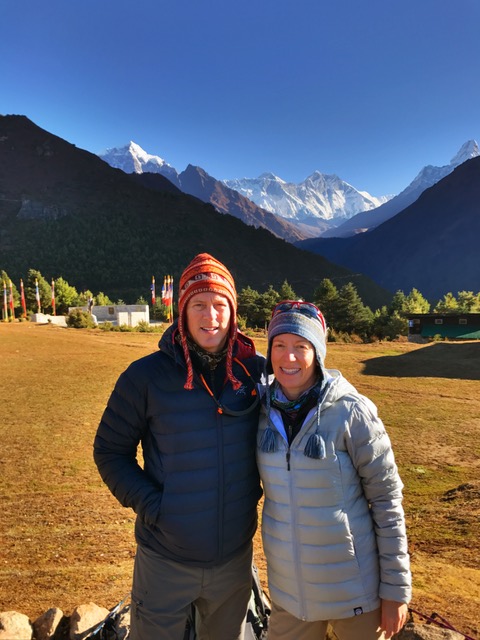
I stopped at the description of a trip to Nepal. It sounded exotic, extremely challenging, and far away. The trip was trekking through the beautiful and mountainous areas of Nepal near Mt. Everest. Starting at Katmandu, adventurers would fly to Lukla and then hike to Namche Bazaar, and then base camp of Amma Dablam mountain at 14,000 feet. Along the way, hikers would visit monasteries and a small village school.
We booked flights to London, and then through Abu Dhabi to arrive in Nepal in late October. We did numerous training hikes with backpacks loaded with sandbags to prepare for this seventy-mile, nine-day hike on rocky trails at high altitudes. Excited to visit the small school in Nepal, I bought notebooks, gel pens, pencils, and other small items to give to the students. Although I wanted to bring more, weight restrictions on the plane from Katmandu to Lukla limited what I could pack for the school. I was excited, nervous, and sure this trek would hold unforeseen challenges and joys.
**********
In mid-October we flew from Atlanta to London, and then through Abu Dhabi to Nepal. The airport in Abu Dhabi for our layover was huge, new, and beautiful, sitting in the middle of the desert. Men and women in long robes and head coverings walked throughout the airport. In Katmandu, the airport was small, chaotic, and dirty, filled with hikers dressed in outdoor trekking gear carrying large backpacks. A visit to the bathroom while we were waiting for our luggage to arrive on the ramshackle baggage carousel reminded me that we were now in a third world country. After our bumpy and dusty ride from the airport, we arrived at a calm, quiet and scenic hotel outside of Katmandu where we could get a good night’s sleep before starting our journey.
Over the next two days, we met our trip leader, Bhala, and the six other hikers going on our trip. We toasted to our upcoming adventure with Everest lagers while we adjusted to the new time zone. We visited Katmandu again and, without the weariness of the long journey, it captivated me with its bright colors, prayer flags, bicycle taxis, crowded markets, and unique charm. We would leave early the next morning to fly to Tenzing-Hillary Airport, also known as Lukla Airport. It was rated as the most dangerous airport in the world due to its extremely short runway nestled at 9,337 feet amidst the mountains. High winds, cloud cover and changing visibility increase the risk for crashes. Many flights are delayed or cancelled, stranding trekkers for weeks at a time in bad weather. Fortunately, I did not know all this before our trip.
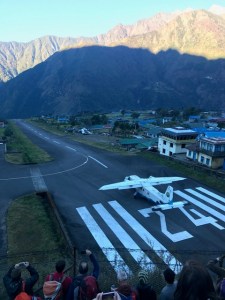
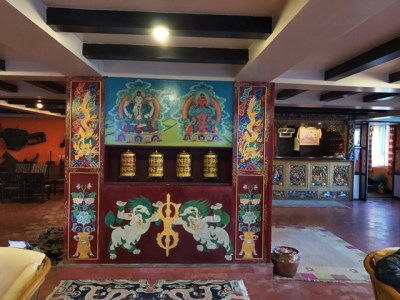
We had an uneventful and beautiful flight through the mountains in a small plane into Lukla on a crisp, clear day. Our pilot was one of the first female pilots in Nepal. I felt safer knowing she had to work twice as hard and be twice as good to get her job. The small town of Lukla is quiet, colorful, and picturesque situated in the beautiful Himalayan mountains. We flew to Lukla with our trip leader, Bhala, and met our two assistant guides there, as well as our three porters who would carry our duffle bags while we hiked. Each porter carries three thirty-pound bags on his back while each hiker hikes with a day pack. We could not have done this trip at high altitudes without our guides and porters. We spent our first night in a charming lodge with colorful prayer wheels in the lobby and small clean rooms with crisp linens and blankets. We ate a simple meal in the lodge dining room and were told to be ready early the next morning.
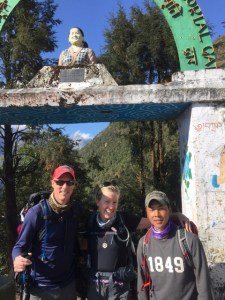
We started our trek through the National Luminary Pasang Lhamu Memorial stone gate that leads to the hiking path. Pasang Lhamu was the first Sherpa woman to summit Mt. Everest and almost everyone who comes to climb Mt. Everest starts here. It felt momentous to be in the same place where many start their epic travels to climb the highest mountain in the world. Not everyone is lucky enough to return. The morning was sunny, and the mountains rose everywhere around us.
I soaked in the beauty and peacefulness of the trek. There were large boulders along the path covered with Nepalese writing. Our guide, Bhala, who is Buddhist, told us that most of this writing is Buddhist prayers or chants. “Om mani padme hum” is one of the more popular chants meaning “Generosity, ethics, patience, diligence, renunciation, wisdom.” It was a nice meditative chant to repeat to myself as I climbed the path slowly in the sun and felt connected to nature in a way that seemed as distant from my life as a corporate executive, as we were from our home in Atlanta, Georgia. Without the constant line-up of meetings, phone calls and never-ending list of e-mails to open and reply, I was able to slow down and enjoy the spectacular beauty of Nepal.

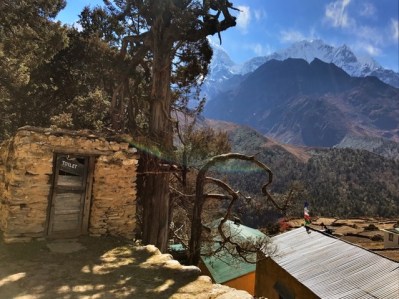
Our first day of the trek was relatively gentle and only four hours long so that we could get used to hiking in high altitude. We wound up and down wide paths through prayer boulders, prayer flags and small towns where young children would wave and greet us. Along the way we would see donkeys loaded with enormous packs of goods to be delivered to the bigger villages further up the path. There were ramshackle outhouses that were deceptively picturesque on the outside but, consisted only of a hole in the ground on the inside. I had to quickly master the skill of squatting and peeing without falling over or peeing on my pants and hiking boots. Easier said than done on the longer, grueling hiking days. Our next sleeping lodge was simpler and colder, a trend that would continue as we hiked higher and higher into the mountains.
The second and third days of our trek were some of the most difficult. They were much longer, with increased elevation gain and loss, and on rockier paths that made it more difficult to maintain your balance and footing. I walked at my own pace and reflected on where I was in my life journey as I pushed through fatigue and aches to reach our destination. More than fifty years had passed by in my life and I was successful and happy, but I also knew I needed more balance and spirituality. We hiked higher into the magnificent mountains, with views of towns and rivers below. Locals created pop-up drink stands on the stone walls surrounding their homes for the trekkers, and a cold drink was often worth the exorbitant price.
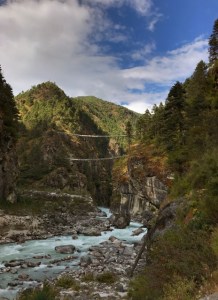
We entered Sagarmatha National Park on day three and crossed over one of the most stunning suspension bridges in the world. In fact, there are two bridges spanning the Dudh Koshi river, one right above the other, and we crossed the highest, newest one. Both are covered with prayer flags waving in the wind. They are nestled in green, tree covered mountains. On this day, the bridge was congested with yaks laden with huge packs and we had to wait to cross until the yaks had cleared the bridge. To be waiting for a yak traffic jam to abate amidst colorful prayer flags fluttering in the wind high in the Himalayan mountains is something everyone should put on their bucket list.
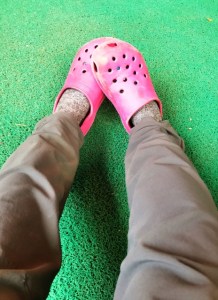
We arrived in our next town tired and hungry. In every lodge where we stayed, the entrance halls had cubbies that were filled with brightly colored crocs. You put your dusty, dirty Yak-poop-filled hiking boots into a cubby and took a pair of crocs that most closely fit your feet. The surprising comfort of pink crocs after a long, arduous day of hiking was wonderful.
The next day we hiked uphill on our way to the biggest town in the region, Namche Bazaar, the gateway to Mount Everest, situated at 11,286 feet with dramatic views of Mount Everest and Amma Dablam mountains, not reachable by car. Along the path we saw porters hauling huge loads, even refrigerators, on their backs to the town. It filled me with gratitude for every item of food or drink I consumed along my journey. Namche Bazaar has bakeries, cafes and even an Irish pub that is allegedly the most remote Irish pub in the world. I had a creamy latte in a cafe there, feeling indulgent on our spartan journey.
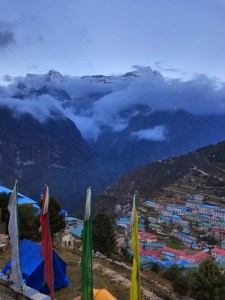
We next visited the beautiful Tengboche Monastery, a Tibetan Buddhist monastery of the Sherpa community. Sherpas are skilled mountain climbers who summit alone or lead hikers up the highest mountains in the region. The monastery is situated at 12,687 feet and is nestled amidst the Himalayan mountains with extraordinary views of Mt. Everest, and all the other well-known mountains in that region. Monks in long robes wandered around the beautiful grounds as we entered through a painted gate topped with golden animals and a dazzling emblem painted with flowers and praying gods. A simple painted sign reminded us that we were entering a holy place where we should “respect worship and meditation.” A list of many rules ended with, “not to kiss please.”
The trip became even more challenging as the altitude increased, the lodges were colder and barren, and the effects of high altitude wore me down, including difficulty sleeping even after an exhausting ten-hour day of hiking. Showers were scarce and lukewarm. In most lodges, the only warm room was the dining room where a large pot-bellied stove heated the room. In your sleeping room, the beds were heated with a hot water bottle which was surprisingly effective when combined with two layers of long underwear, at least until the early morning hours. Dinners were always simple and delicious after our long days.
At this point in the journey, we were travelling on narrow paths winding through the mountains high above the tree lines. There were fewer towns and people along the paths surrounded by breathtaking views. We were approaching our last upward hike to Amma Dablam base camp at 14,000 feet when I suffered severe stomach cramps. Extremely disappointed, I had to take a day of rest and miss the base camp excursion.
We started hiking down to Phortse village the next day and I felt better as the altitude decreased. Our accommodations in Phortse were the barest—small cold rooms with twin beds and no toilets. The outhouse was outside, past the woodpile in the dark of night where I, of course, had to pee three times. Staying hydrated in high altitude has its downsides! The wooden stove in the dining room was fueled by smokey, smelly Yak dung as we were still above the tree line and wood was scarce. The joy of our hosts in our visit, however, easily outweighed the discomforts.
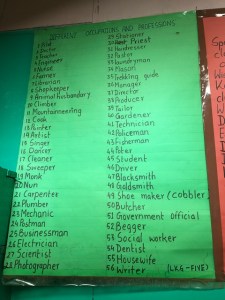
We visited the Phortse school the next day. It was a plain three-room school. There were no indications of 20th century modernity anywhere. The walls were covered with handmade posters and drawings. Lessons written on the walls stated: “Stop early marriage; it is a sin to practice untouchability; both son and daughter are equal.” Another sign listed 56 different occupations and professions, including: pilot, climber, monk, trekking guide, butcher, begger [sic] and last on the list, writer. There was no lawyer on the list as monks resolve disputes in the local communities in Nepal.
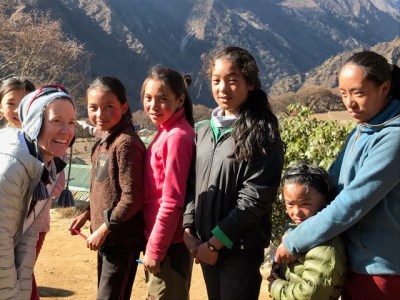
The kids lined up to receive the small gifts that I had brought to share with the school. Gel pens and composite notebooks were greeted with wide smiles. Unlike the schools in the bigger villages, these children, ranging in age from five to thirteen, had no crisp uniforms. Their parents brought them to this meeting and watched cautiously from the side. This was a poor village where the community worked hard for little.
We continued the trip back to Lukla over more flagged suspension bridges, through more small towns amid more spectacular views. Our last night of the trek we stayed at the Mt. Everest View hotel with a dramatic view of Mount Everest. It was supposed to be the nicest lodge on our journey, but the heat and private showers were not working. At this point though, we were used to hot water bottles and shared bathrooms. We knew that we would soon be back in more comfortable hotels. We would miss the stunning mountains, the crisp cool air, the children running to greet us on the rocky paths, the yak and donkey traffic jams, as well as the warmth and generosity of the people of Nepal who welcomed us along our journey. We might even miss the rickety outhouses with signs like “Ladies and Gents,” accompanied by glorious mountain views.
We finished our trip in early November. I was proud of myself for completing a journey that was totally out of my comfort zone. We celebrated with a final dinner where we gifted prized possessions like hats with built in headlamps, warm fleeces and coats to our guides and porters, along with the customary financial tips. We appreciated how they made our trip possible and wanted to give them items they couldn’t buy in Nepal. David and I also followed up with Bhala to establish a fund to help the Phortse school buy uniforms, backpacks, coats, and sneakers for all the kids in the school. We have done that every year since we visited Nepal.
I think often of this beautiful country that helped me connect with nature, trust in my body, and reinvent myself. As Rumi wrote, “It’s your road to walk alone. Others may walk it with you, but no one can walk it for you.” That may be true, but in Nepal, the Nepalese people walking with you made all the difference.
 A Year at Stanford