Featured

Stanford DCI 2023 Update

First, if you are new here and want to follow my journey chronologically, please start with my First Quarter Reflections and then follow on to Second Quarter Reflections, Third Quarter Reflections and then, finally, this post.

Apologies to the few of you who follow my blog—I realize that it has been a while. I got so busy being a Stanford student and commuting back to Atlanta too often, that I have failed to provide any DCI experience updates. I rationalized this by telling myself that I was so busy learning and living in the moment that I didn’t have time to update my blog. Truth be told, I had some setbacks in the summer of 2022, and I fell out of the habit of keeping my blog updated. So here I am, repentant and back at it!

The last time I updated my blog was to write my Third Quarter Reflections about my Stanford Spring quarter of 2022 and now I am just finishing my Stanford Spring quarter of 2023. What?! Yes, I’m still here at Stanford. We liked it so much and the Stanford DCI program gave us the opportunity to continue as DCI Continuing Fellows for a year and so we said, YES. Why not? We like the student life and learning from so many amazing professors about so many interesting topics. We like the CA weather, biking to class and living in Palo Alto with our new friends so we said Yes. It’s been another year of growth and change.

Summer Quarter 2022: I think the best way to update you is to go back to the Summer of 2022. As I mentioned earlier, I had a few setbacks that summer. It was our last quarter of our first year DCI experience (we started in September of 2021 and had initially planned to end our DCI experience after the summer of 2022). I got Covid in June following a family wedding in Florida and then three weeks later, I got a concussion (don’t ask, but since I know you are asking/wondering, suffice it say I sat down in a darkened room where I thought there was a seat but there wasn’t….and I walloped my head). So, my last DCI summer which was to include a class on The Genius of Oscar Wilde, a class on Witches in Early America, Intermediate Memoir and lots of yoga, tennis, and golf included just those three classes and no sports whatsoever. It was still fun once I recovered from my illnesses, and I enjoyed the classes on Memoir, Oscar Wilde, and Witches, but it was an inauspicious end to a year where I had way too many health scares (Melanoma, torn MCL, Covid and Concussion). I am much more acutely aware of, and grateful for, the value of having good health and how quickly it can disappear.

Fall 2022: We decided to extend our Stanford DCI experience but take a break from Stanford for the fall. I needed to get home to Atlanta to help my mother with a lot of things, and we had a big family trip planned in December to Chile. As I delved deeply into my mother’s issues, it became apparent that she needed a lot more help than I had originally anticipated. My fall was spent primarily helping my mother find a retirement home near me in Atlanta, move her, sell her condo, and get her settled in her new home. It was a full-time job and I’m very glad we made the decision to move her. She is much happier and healthier in Atlanta. I recently wrote a piece about my mom which is attached in the creative writing file called “Fireflies.” And the trip to Chile was spectacular!

Winter Quarter 2023: Once I got my mom settled in Atlanta, I found additional support for her and asked other family members to come visit her in Atlanta while we went back to CA. We decided to live in Palo Alto this time (instead of Menlo Park where we were last time). We found a nice furnished condo right in the heart of Palo Alto which is a quick bike ride to campus and a short walk to numerous restaurants. I jumped back into taking classes like it was my job! Here are the classes I took:

  • World Democracy with Prof. Larry Diamond. This class met 2x a week and we explored democracies across the world and where democracy is succeeding and failing. Prof. Diamond is brilliant and has spent his life studying democracy across the globe. What made this class even more interesting is the fact that we had several Knight Fellows in the class. These are journalists who are here at Stanford for a one-year fellowship. In our class we had journalists from the Philippines, Guatemala, and Turkey (notably the Turkish journalist is now a filmmaker as he lost his job when Erdogan fired all the independent journalists in the country). Additionally, we had a visiting professor from China who took the class with us. This added to the amazing discussions we had about democracy and autocracies around the globe.
  • Tech, Public Policy and Ethics. This was an amazing class taught 3x a week by three Stanford professors. Prof. Mehran Sahami who is the head of the Computer Science department at Stanford, Prof. Rob Reich who is a Political Science professor (and was also my daughter Halle’s advisor for her Stanford Honors thesis), and Prof. Jeremy Weinstein who is also a Political Science professor. All three professors were simply amazing and that made the class spectacular. The class looked at the ethical issues with algorithms (who writes them and how do their biases run through the algorithms), policy attempting to regulate tech, and ethics around tech. We discussed Chat GPT, cryptocurrency, FTX and more. It was an enlightening and fascinating class. These three professors have co-authored a best-selling book called System Error: Where Big Tech Went Wrong and How we can Reboot.
  • Sports Writing. I took a different version of a Sports Writing class taught by John Evans who I have taken classes from before. It was a great class where we read a lot of different sports pieces (many of which are just amazing) and wrote our own essays. My essay about my daughter Kendall is attached in the creative writing section of this blog. It is called “Payne Train.”
  • Climate and Civilization. This was a weekly class with different guest lecturers discussing climate and sustainability. I learned a lot on a high level about different climate issues and proposed solutions and/or related policy issues.
  • Art History. I also took an online continuing education course taught by Professor Alexander Nemerov called: Along the Watchtower: Six Photographers of America, 1966-1976. It was an amazing class exploring six photographers, only one of whom I had heard of before, Diane Arbus (pronounced Dee-anne, who was Prof. Nemerov’s aunt).  The photographers: Diane Arbus, Catherine Leroy, Paul Fusco, Larry Clark, Ralph Eugene Meatyard, and William Eggleston. Prof. Nemerov explored the “magic of picturing—of what makes a good and even a great photograph, even when the times are dark.” I particularly admire Paul Fusco’s photographs of the people who lined the railroad tracks to pay homage to Robert F. Kennedy when the train carrying his body passed through the United States on the way to Washington, D.C.

Spring Quarter 2023: My final quarter at Stanford was bittersweet. I felt almost like a senior, with a bit of school burnout, yet also realizing I won’t ever pass this way again. Here are the final classes I took:

  • Music 8A: Rock, Sex and Rebellion. Yes, you read that right. This was an awesome class that met 2x a week and was taught by one of Halle’s favorite professors, Prof. Mark Applebaum. I have always enjoyed music, but this class helped me to understand it better and appreciate the blues beginnings of rock and roll. Prof. Applebaum taught us really complicated musical concepts combined with an incredible playlist every week. It was fun to be in class with kids who were not born until after 2000 and see their reactions to music from the early 1900s and beyond. We had so much fun!
  • History 1C: Global History through Graphic Novels. This was a fabulous history course taught by Prof. Thomas Mullaney (who won the Stanford Professor of the year award this spring so you can imagine how awesome of a professor he is). It was a whirlwind tour de force of modern history accompanied by readings of super interesting graphic novels like Maus, Run for It, Persepolis and more.
  • Public Policy 103F: Ethics of Truth in a Post-Truth World. This class was taught by Prof. Susan Liautaud. She is an amazing professor and an expert in ethics. She has written numerous books and consults with numerous corporations to advise on better ethical frameworks and decision making. This class was a fascinating discussion of truth- what it means today and how we all interpret it. It was a small class of approximately 5 DCI students and 16 undergrad students. The discussions were powerful and fascinating. I highly recommend Prof. Liautaud’s book, The Power of Ethics.
  • Japan: Tokyo, Kyoto, Osaka and beyond. As part of expanding my understanding of different countries, I took this class on Japan with Prof. Indra Levy. I really loved this class. We watched a lot of interesting Japanese movies and read many interesting Japanese novels and short stories. Prof. Levy led great discussions. This helped me get a real sense of what Japan is like. I can’t wait to visit!
  • Political Science 62: Defending Democracy at Home and Abroad. This class was taught by Prof. Michael McFaul (former Russian Ambassador under President Obama), Prof. Rob Reich and Prof. Marietje Schaake (former member of the European Parliament and director of policy at Stanford’s Cyber Policy Center). The class met 1x a week and featured various guests (such as the former President of Mongolia) speaking on democracy. Each class featured a Q&A where robust discussions were often had among the various students.
  • Seminar on The Science of Action. I also took a workshop taught by Prof. Sebastian Kernbach on how to not procrastinate. Great tips on how to come up with that “first shitty draft” and keep things ideating and moving along.

Fireflies

Kathy Payne

May 10, 2023

Sun Valley Writing Project

Fireflies

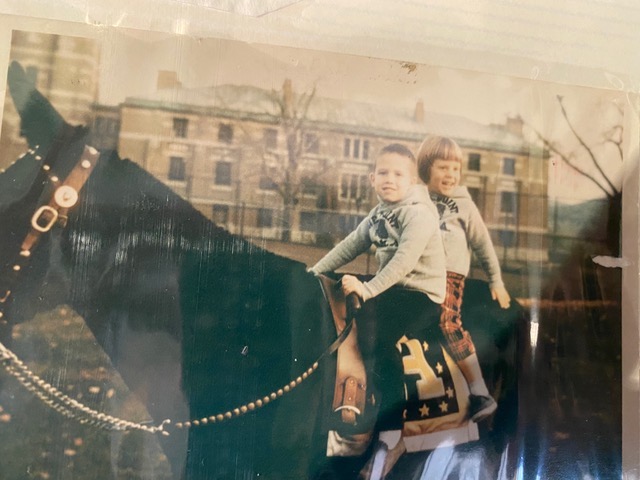
A memory from long ago comes back to me. I am six and living in the pink house on Ebenezer Road in Rock Hill, South Carolina, the town where my mother and father both were raised. It is the house between Mr. and Mrs. Godfrey on the left who are older and sweet and gave me a wallet for my birthday, and the house on the right where a woman whose name I can’t remember gave me my first pixie haircut in the small salon attached to the side of her house. I hated the haircut then, but looking back at faded black and white photos, it was adorable. My mother was right.

I live in the pink house with my paternal grandmother Katharine, my mother Doris, my brother Jimmy, our black poodle Schatzi and our grey cat Nutmeg. My dad is away fighting a misguided war in Vietnam and my mom cries a lot, scared that he is not coming home. I don’t understand the risks—I just know I miss him terribly, but I also like the Vietnamese dolls and silk pajamas he sends me. I wish he was here to swim with me in the pool Katharine put in her back yard. I am lucky to live in a pink house with animals and a pool. I miss my dad though.

We go over to my Aunt Gertrude and Uncle Paul’s red brick ranch house for dinner. They are the ones who took my mother in when she was eleven and her dad remarried. As we arrive, Paul is frying the catfish he caught fishing and making hushpuppies from a corn meal mix in the open carport. My brother and I rush to help. Katharine, Gertrude, and Doris have sweet tea in the living room and Paul sends Jimmy and me on a quest to see who can catch the most fireflies in the mason jars with tin lids that we have poked holes in for air. We run around the front yard as the light dims, and we catch the elusive fireflies with their taillights that flicker off and on. Katharine comes out on the porch stoop and laughs at us. Like her son, my dad, she has an amazing laugh that is best when she laughs so hard that she snorts. She does this often when we are around. Then my mother leans out and shouts, “Dinner. Come and get it!”

                                                            **********

I’m having trouble adjusting to my new reality of not being a high-powered business executive. My expectations don’t meet my current circumstances. I’ve been managing my mother’s life for the past few years, and it is a different kind of stress altogether. One where no one else has the same sense of urgency that I have. Certainly not my mother who had let her life fall into shambles around her over the past few years. Finances needed to be straightened out after an unscrupulous advisor took advantage of her. Overdue bills needed to be paid. Her condo and car both needed major repairs. And, finally, my brother and I made the decision to move her to a retirement home near me. It’s been a lot. I’ve done it without any corporate bonuses or accolades. Unlike when I worked in the business world, no one seems to have any timeline or urgency to respond to my questions or concerns. In fact, it often seems like no one cares.

After she moved into her new place, my mom told me that this latest move across country to her new retirement home was the easiest move she had ever made. I almost spit my drink out. I laughed loudly. “Well of course it was,” I said, “you didn’t do anything.” It’s almost funny if it didn’t make me cry. In her defense though, she did move our family a lot over the years and I’m sure I wasn’t at all helpful for those moves. So, yes, this move was a lot easier for her.

I spend a lot of time, talking to nurses, physical therapists and all the numerous caregivers who take care of my mom now. She doesn’t really know how much time it takes. But I think she knows that she is safe and taken care of and that I have a lot to do with that. She does thank me, even if it is usually followed by the statement, “Well of course, I raised you well.” My new role is one where patience and kindness matters most and I’m not skilled in those areas. I’m much better at being the person who makes things happen, the person who solves problems.

I stop by to say hi and check in on my mom. She’s forgetting a lot these days. I encourage her to take a shower while I’m there and wear something nice to the retirement home’s New Year’s Day party. “There’s a party?” She asks this with total delight and surprise. “Yes, you would know that if you actually left your apartment and saw the notices in the elevator.”  I say this gently, but I really would like her to leave her apartment more.

Baby steps. I say this to myself often. While she showers and dresses, I polish her silver service and untangle all her necklaces that got tangled in the move. Her apartment is starting to look nice. Like the home she left. I remind myself that it’s been a lot for her to move. It really has. I pat myself on the back for making it happen.

**********

I didn’t always get along with my mother. I remember once being upset when I was a teenager because my father sided with my mother in an argument when I knew I was right. He later told me a story about how my mother and I were the two most important women in his life. He loved to impart “life lessons” through stories. He said in his faint southern drawl that I was going to leave him one day soon, while he was going to spend the next twenty-five years with my mother. He cocked his head and asked me gently, “Who would you side with?” I snidely replied that I would side with the person who was right. At that point, I knew I was doomed and ceased the pointless arguments with my mother. I was never going to win.

I think about my mother’s life growing up. It wasn’t easy. As she is losing her memory, I think of all the things and people she has lost along the way. She lost her mother when she was six. She went to bed one night with a mom who loved to have Doris help her in the kitchen and woke up with a distracted and absent father. She lost that father five years later, when he married another woman and she and two of her sisters moved in with their older sister, Gertrude. She lost her nanny, Willie Mae, at that same time—the person who kept her safe and loved during those years after her mother died. The person who took her to church and told everyone to be nice to Doris because she lost her mama. To this day, Doris recalls with love, and admiration, her memory of how Black women dressed for church with fabulous hats. The hats remind her of Willie Mae, a strong woman who loved my mother at a time she needed it most.

She lost many belongings and left friends behind during the multiple moves as an Army wife—at least fifteen moves by my count before this last move to her new retirement home. She lost twins at the young age of twenty-four in a different country. The arrived too early and didn’t survive. She didn’t even know she was pregnant with twins until it was all over. She almost lost me as an infant, choking on something, but paramedics arrived in time. She almost lost my brother to anaphylactic shock from wasp stings, but he got to the hospital in time. She’s lost so many friends to illness and old age that she has lost count.

She lost every one of her eight siblings: Albertus, Anne, Gertrude, Bertha, Emily, Jimmy, Laura, and Sally. She lost her eldest sister Anne to Alzheimer’s disease. She took care of Anne until the end, remembering all that Anne had sacrificed for Doris to send her to college and take her away from the future of mill work in the small southern town where they all grew up. She lost Gertrude, who took Doris in despite a young child of her own and the hard life of shift work in the fabric mills. She lost her mother-in-law Katharine to emphysema—the one who lived in a pink house that we all shared while my father fought in Vietnam. She is the only one left to remember the Hearon legacy, to remember what it was like to grow up after the depression in that South Carolina mill town known for producing gingham fabric.

And hardest of all, she lost her husband Jim to a Glioblastoma brain tumor when he was seventy-six. She thought he would live forever, it anyone could. He ran marathons and went helicopter skiing at seventy-four. She lost the person who loved, cherished, and spoiled her more than anyone. They met at fourteen in high school biology class and were together for the next sixty-two years. My dad liked to say that Doris was the most beautiful girl he had ever met. He simply could not believe my mom loved him despite his teenage acne. My mom loved Jim for his brilliance, kindness, and zest for life. He was from a family of educators and became an award-winning professor at the United States Military Academy where Doris spent two decades of her life as an officer’s wife. How could he have left her behind like all the others?

But throughout it all she has remained grateful. She has had a very good life. She looks at all she gained, not what she lost. She remembers the good—her large family, her amazing husband, her two kids who lived, her life of travel and her life now in a beautiful apartment in her retirement home in Atlanta. Sometimes she rewrites history a bit to take out the bad parts—but don’t we all do this and live a bit in revisionist history?

                                                                        **********

It was Doris’ 90th birthday on April 25, 2023. I couldn’t be there. I sent e-mails to all her caregivers to help make her day special. I sent a beautiful orchid on behalf of all her family. I reminded everyone to call and text her and send her cards. I reminded her to check her mailbox. My friends stopped by to visit her on her birthday. They gave her a birthday balloon and a birthday throw. They sent me pictures of a smiling Doris.

My brother and I went to Atlanta the weekend following Doris’ birthday to take Doris out to dinner. She had a large martini with olives, a little food, and a lot of dessert. We took many pictures and celebrated all she’s lost and gained. Ninety years of living…of moving forward…of the people who made Doris who she is, who touched her and who she touched along the way. I posted a photo of Doris enjoying her birthday celebration on Facebook and it garnered more likes than any other photo I have ever posted. She loved seeing all the birthday greetings from near and far. She loved her momentary celebrity status as the ninety-year-old birthday queen.

                                                                        **********

At the red brick ranch house in South Carolina, we eat our delicious meal of catfish and hushpuppies while drinking our sweet tea. I feel loved and safe with my Uncle Paul, Aunt Gertrude, Katharine, Doris, and Jimmy despite my father being so far away across the globe. At the end of the evening Paul tells Jimmy and me that we need to let the fireflies go. “It would be cruel to keep them,” he says. Jimmy protests because he is sure that he has caught more than me and we should count them first.

We open our jars gingerly and the fireflies, like Doris’ memories of her life and the souls of everyone she loved and lost along the way, fly tentatively and gently into the warm, muggy southern skies.

I think now of my father, grandmother, aunt, and uncle long gone and only seen in photographs today. I think of their love and lessons imparted. I think how much Doris must miss them. I think of those southern nights, and I miss them too. But the pink house, the Vietnamese dolls and silk pajamas, the hushpuppies, sweet tea, and the flickering fireflies are imprinted on all our souls in a way that not even time can erase.

Payne Train

Kathy Payne

2023 Sports Writing Final Essay

Payne Train

I passed the artwork hanging on the wall as I ascended the stairs to the sound of Kendall’s sobs. I saw Kendall’s musical mixed media collage and Halle’s self-portrait. I passed the framed artwork and ribbons for the library “bookmark” drawing contest. Halle won first place and Kendall second, to which Kendall always retorted that her artwork was best, but Halle won because she read all the books and was a suck up. Kendall was not totally wrong in this instance. Both my girls are artistic and funny.

On Kendall’s door was the self-portrait she made in middle school—a photo of Kendall in her gym shorts and t-shirt doing a backbend was a bridge, and then there were multiple photos of Kendall walking over herself. Her large bulletin board was covered with more artwork and numerous swimming ribbons. Her bookshelf was replete with her favorite books, many of which we read out loud together to conquer her dyslexia: Where the Sidewalk Ends, A Wrinkle in Time and the entire Harry Potter series. Also, trophies from her many athletic achievements in swimming, soccer, basketball, tennis, triathlons, and volleyball. She was even on a jump rope team in elementary school. The slanted bedroom walls of the converted attic space were covered with inspirational quotes and hundreds of photos that she took over the years of all her friends and travels. This room was a microcosm of her years growing up in Atlanta.

Now twenty and in college, Kendall had finally settled into school, found her people and her new sport—Ultimate Frisbee. Best of all, she seemed happy.

*****

The crowd in the small high school gym started chanting and making the sound of a train. Chuga chuga chuga chuga woo woo! Chuga chuga chuga chuga woo woo! They kept repeating the sound, growing louder each time, as my daughter Kendall stepped up to serve. One of the guys in the crowd brought a whistle—a wooden one that sounded like the train siren going off. Unimpressed by his creativity and effort, the referee told him that it wasn’t allowed. 

Kendall was a senior and the setter on her high school volleyball team. She was an excellent server and often went on a streak that put the team well ahead for the win. She served powerfully, overhead in a quick sweeping motion with her flat hand hitting the ball with force. She focused with intention. She went in for the kill, like a lion spotting a hyena across the field.

The crowd continued to chant the sound of the train coming down the tracks. It was the first time I’d heard them do this. Chuga chuga chuga chuga woo woo! The crescendo was building. It didn’t seem to faze Kendall at all. In fact, she seemed to like it. She pounded the volleyball on the floor in front of her waiting to throw it into the air for her serve. She had a process, seven bounces of the ball in front of her and then a high toss into the air.

Right as she served, the crowd shouted “Payne Train” at the top of their lungs in culmination of their chant. She released her powerful serve, and it was an ace. She turned and winked at the crowd as she grabbed the volleyball for her next serve. The chant started its low murmur again.

I was watching, stunned. Kendall lacked confidence in almost everything else surrounding her high school experience, yet here she was working the crowd. She was a talented athlete, but as her confidence had faded, she had quit many of the sports she loved– soccer was the first to go with Kendall insisting that she had peaked in the soccer game where she scored ten goals when she was six.  Basketball was next– she said the mean softball girls’ clique on the basketball team made the team unbearable.

                                                                        *****

I remembered back to elementary school when I signed her up for tennis. I was sure she would like it. She had great hand/eye coordination and was agile. Plus, I loved tennis and had visions of us playing together. I made the fateful mistake of including her on a team of her friends who had already played together for a year. She hated it. She was furious that I signed her up for a sport where everyone knew what they were doing except her. She begrudgingly completed her season and never played tennis again.

I somehow convinced Kendall to try out for the volleyball team in 7th grade. She didn’t want to because she didn’t know how to play. Remembering the tennis fiasco, my key persuasive argument was that no one knew how to play volleyball in middle school in Georgia. She reluctantly agreed to try out and made the team. She had a nurturing coach who understood middle school girl dynamics—something I was constantly baffled by. 

Kendall started at this private school in 6th grade, and it had been more difficult than either of us imagined. I had a busy and challenging career that left little time for socializing, so I was never in the “moms in the know” group— a fact that I quickly realized penalized my child as well.

Kendall entered school with new braces and perfect timing for the middle school awkward stage. She made a few other awkward friends, but most of the girls at the school had known each other since kindergarten and were not kind to newcomers. One day, a girl in Middle School said “Bless You” when Kendall sneezed. However, when that girl turned and saw that it was Kendall who sneezed, she snorted derisively, “Oh it’s you, never mind.” Maybe that’s why Kendall loved the movie “Mean Girls” so much. It rang perfectly true. 

*****

I would rush to watch the middle school volleyball games from the bleachers, frazzled from work and rush hour traffic. It was clear who the popular girls were. They all sat together on the bench and cheered each other on. Although Kendall was one of the better players, it didn’t seem to help her social standing in the slightest. The cheers for her were faint and half-hearted. Still, she powered on and became better each game. She liked it so much, she asked to try out for the volleyball leagues that played in the off season, where she traveled all over the state playing other teams, staying at cheap hotels, and eating shared meals at the local Olive Garden.

My husband and I traded off who was going to volleyball matches and who was taking our younger daughter, Halle, to gymnastic meets in small towns throughout Georgia. Five hours of waiting amidst glitter and sparkling leotards to see your daughter perform for a total of five minutes where your heart stopped repeatedly from the backward flips on the balance beam or crazy releases on the uneven bars. I liked volleyball better.

As Kendall entered High School, she seemed a bit more confident, or at least not miserable like she was in Middle School. She had a very small group of good friends and found her niche. Volleyball and yearbook took up most of her time. She continued to swim, landing on the high school swim team where no one got cut. She even tried out for golf and made the team although she never played an actual match.

Looking back on Kendall’s and Halle’s years of athletics, our family spent countless hours traveling all over for practices and games, often at inconvenient and distant locations. For years we had two soccer games every Saturday in the spring and fall, two basketball games every weekend in the winter, and never-ending swim meets on Monday nights in the summer. Then, the girls parted ways into different sports, with volleyball, basketball, golf and swimming for Kendall, and gymnastics, diving and cheerleading for Halle. A constant whirl of activity.

Maybe I was trying to make up for the lack of opportunities I had to play team sports when I was young. I wanted my girls to be confident, tough and learn team dynamics, all of which I believed would help them in their future careers. David just thought it was good for them and would keep them exhausted and out of trouble. Whatever the reasons, our kids thrived and became confident through all these sports.

So, although it had been hard for me to see Kendall’s confidence shattered in this new school, volleyball grew to be kind of a salvation for her. She gained her confidence back while she was out on the court leading her team, even if she seemed confused and angry off court. The team performed well her senior season and went far in the state playoffs but lost the quarterfinal game to a team in Savannah. Kendall was selected as the team MVP her senior year—which was her crowning athletic achievement to date—better than that ten-goal soccer match from long ago. She was also selected as the most improved swimmer on the swim team.

But social life was challenging. Kendall had a best friend, Aziza, who she would see multiple times a week, but one day Aziza just disappeared. When I asked Kendall what happened to Aziza, she told me that she didn’t want to talk about it. I assumed they had gotten into a big fight. Kendall didn’t get asked to her senior prom. Every time I tried to ask about it, she erupted in tears or shouted, “Leave me alone!” A friend of hers ended up setting her up with a guy from another school she didn’t know. It was not the prom of her dreams. 

Throughout her senior year, we seemed to be in constant battles with Kendall. Nothing we did seemed helpful or right. She was anxious about everything. I tried to convince myself this was just normal teenage jitters about all the big changes ahead. College is a big change for anyone. But it seemed to be more than that and it worried me that Kendall was unhappy. The only place she really seemed relaxed, focused, and happy was on the volleyball court.

High School graduation came and went. Kendall graduated with honors and was accepted into The George Washington University with a Presidential Scholarship. She went off to college still confused and angry. I didn’t understand her constant agitation and frustration, most of which she took out on me. When people asked me if I cried when I dropped her off, I responded, “Yes, it was awful, but I know she is going to thrive at GW.” To my close friends, I was more honest, “No. I almost threw her boxes out the window and yelled, ‘Call us when you’re grateful!’” 

*****

Entering her room that night during her college break, I said, “What’s wrong?” I said this gently since she wasn’t a crier. “It’s Christmas, you should be happy.” “Megan broke up with me and I don’t want to talk about it,” she blurted out. My mind clicked forward like an old computer processing computer cards. Kendall had met Megan through her new sport, Ultimate Frisbee. “Megan broke up with you,” I said with confusion. “Mom, you knew,” Kendall sighed loudly. “Hmmm…honestly, no I didn’t. Maybe I should have,” I said, “but I didn’t.” I felt desperate to say the right thing. “I love you,” I said. “I’m glad you told me. I love you exactly as you are. And, ugh….” I sighed deeply. “It sucks to be broken up with.” Kendall laughed through her tears and snot, “Yes it does,” she agreed. 

She didn’t want to talk about it further. It was like the relief of telling me who she was had exhausted her. I looked back at the last few years and felt guilt for what a shitty mother I must have been. Was I always working too much and preoccupied? How did I not understand the stress she was going through? How did I not get that Aziza was her girlfriend? How did I miss all the signs? I cried thinking how I might have protected her better and made her life in high school more bearable. Growing up gay in the conservative south is not an easy thing to do.

I think, in retrospect, maybe Kendall didn’t need my protection. Maybe all those years of sports prepared her to fight for herself in every way necessary. To believe in herself like she had believed in her volleyball serve. Maybe she also knew that we were a team who had her back whenever she was ready to tell us who she was. 

The night after Kendall told me she was gay, I cried talking to my youngest daughter Halle telling her that I was afraid that Kendall’s life would be harder. I was completely accepting of her sexuality, but I was afraid that she would face hate and discrimination from others. As a parent, you worry all the time and want to protect your children. Yet one of the hardest jobs as a parent is allowing your children to gain their own resilience. To fall and get back up. To learn that life goes on if you don’t win the State Championship. To learn that not everyone is going to like you or who you love. Halle told me, “Mom, we all have something that makes our life harder. I’m a perfectionist and have anxiety. You’re also a perfectionist and Dad’s dealing with the scars that his father left behind.  We’ve all got something that makes our life harder, but also in the end, richer. That’s just Kendall’s something.”

******

Good comedy doesn’t grow out of the good things in life. It grows out of coming-of-age trials, growing up gay in the South, surviving sports teams, retractions of “God bless you,” and, figuring out what it means to be gay in a world that is not quite ready for you and entering in through the door regardless.  

Kendall and I talk all the time now and she is, indeed, very grateful. Grateful, funny, and brave.

Kendall just moved into an apartment in Brooklyn with her girlfriend Alicia, whom we all adore. She has a great job and does stand-up comedy in Brooklyn. I’ve been to many of her shows, and she is hilarious, even when I am the butt of her jokes. How could anyone resist the temptation, “My mom’s here in the crowd. My sister just recently came out to her as bisexual, to which my mom responded, ‘but you’re my straight kid.’” Low judgmental murmurs pulse through the crowd. “That’s right!” Kendall shouts. “Stay in your lane bitch, I’m the gay one in the family.” I laugh along with the crowd. Yes, I really did say that. She also incorporated the “Bless You/Never Mind” story into her show when the “bully” was in the audience. Revenge is sweet. 

Kendall was asked to come back to her private high school and speak with the students and teachers about the trials of growing up gay in Atlanta and how both teachers and students could be more inclusive. She’s writing a screenplay about a wedding featuring several gay characters, who are the stars of the show. She is hilarious about the trials of corporate life and could write a sitcom just on those stories alone, like when a boss who hired her was fired on her first day of work (spoiler: Kendall was fired three excruciating months later). She plays on a Brooklyn Ultimate Frisbee team. She is a happy young adult doing her best to live out her dreams in the “Big City.”

Or as Kendall would say, “In a M. Night Shyamalan twist Mom, I’m actually thriving.”

Third Quarter Reflections

I’ve finished my third quarter as part of the Stanford Distinguished Careers Institute (DCI). Here are my continuing reflections on this amazing year of study and reflection.

If you are looking at my site for the first time, here’s a description of the Stanford Distinguished Careers Institute (DCI) and me, Kathy Payne.

What was different about this quarter?

The spring weather was wonderful, although the weather was somewhat erratic. It would be 90 degrees one day and in the low 60s the next. You get used to having layers with you at all times in northern California. I took a lot fewer classes this spring quarter, so I had more time for white space- such as informal gatherings and the ability to relax more. I completed my Life Transformation Reflection which was hard and important for me personally- it’s hard to put into presentation form what transformative moments in your life made you who you are. It takes a lot of vulnerability and self-reflection. I think it is one of the unique things that makes this program so compelling. I am sad that the year is almost over.

What classes did I take this quarter?

I took 6 classes plus continued in my book club on “The Meaning of Life” and with my personal trainer. It’s hard to say no to all the interesting classes to take and things to do here, but I did a much better job of balancing that this quarter. After being such a goal oriented and over-scheduled person your entire life, it’s a challenge to slow down and learn to define productivity differently.

For Spring Quarter, I took 3 undergrad classes, 1 Stanford Graduate School of Business (GSB) class, 1 Stanford DCI only class and 1 Stanford continuing education classes. I loved all my classes again!

Additionally, every Tuesday night we continue to meet as a DCI group and hear a guest lecture from a different Stanford professor each week. At these meetings, one or two people in our class present a twenty or thirty-minute presentation called a Life Transformation Reflection (LTR). These are always very powerful and moving presentations on something meaningful and transformative in their life. As noted above, I completed my LTR—I’m glad I did it and I’m also glad it’s over!

Here are short descriptions of my classes:

  1. The American West. This class met 2x a week and was taught by four legendary Stanford Professors: David Kennedy (History; Winner of the 2000 Pulitzer Prize for History), David Freyberg (Civil and Environmental Engineering; a hydrologist and water resource expert), Shelly Fishkin (English literature; expert in Mark Twain) and Bruce Cain (Political Science; Dir. of the Bill Lane Center for the American West). This class was phenomenal. I learned so much about the American West from the perspectives of these four professors- Water (it’s a huge issue out West and the water rights are so different than the East), Literature (Prof. Fishkin explored the literature of the West from the perspective of many minority voices who have not been heard from or listened to enough); the politics of the West and how the West’s origins influence that; and the history of the West- from Native American culture, the building of the railroad, the gold rush and the impact/magnitude of federal land ownership in the West. I never understood the significance of the 100th meridian until now! Everything to the West of that is truly dramatically different than the rest of the U.S.
  2. Understanding Russia. This class met 2x a week and was taught by Prof. Kathryn Stoner. Again, amazing class. Prof. Stoner is an expert on Russia and the Mosbacher Director of the Center on Democracy, Development, and the Rule of Law. I learned so much about the history of Russia and Putin’s trajectory and power in that country. We had several Russian and Ukrainian students in our class, and it was fascinating to hear their perspectives on the current war and its impacts on Russia and Ukraine. I have a much better understanding of this huge nation and its impact on the world.
  3. The Law and the Brain. This class was an undergrad class taught by a neuroscientist David Eagleman who is a Stanford professor and also runs the non-profit Center for Science and Law, which seeks to align the legal system with modern neuroscience. The class was co-taught by Octavio Choi, who is an interventional and forensic neuropsychiatrist on the Stanford faculty. This was a new class taught by Professors Eagleman and Choi and I really enjoyed it. It met one time a week for 3 hours and explored various cases and readings on how the law treats those with mental illness accused of heinous crimes and how neuroscience impacts such cases. Super interesting and informative.
  4. Into the River. Like my Redwoods class and Dunes class that I took in the Fall and Winter quarters, this class was taught at the O’Donoghue Family Farm which is an actual organic farm on Stanford’s campus (which is also called “The Farm”). This fact added to the unusual and calming nature of the class- learning outside while butterflies floated by, and birds chirped—as spring returned to campus. In this class we explored how our roots (childhoods, stories we’ve learned or told ourselves as we grow up) form who we are, but then often no longer serve us. We focused on integrating our internal and external lives. We spent a weekend retreat in Philo, California where the theme of the retreat was death. I know, right?!? But, seriously, contemplating death makes you think deeply about how you want to live your life right now! As part of this class, we all had to choose a “courage project” that we want to bring to fruition that integrates skills we have with something we’ve never done before that will leave a legacy for others. More to come on that as it evolves.
  5. Negotiating in Sports and the Media.  I took this class at the Stanford Business school (everyone here calls it Stanford GSB). I know you’re thinking- isn’t that what you did with your entire career Kathy? And, yes, that is what I did for most of my career. But I thought it would be interesting to see how Stanford GSB teaches negotiation and to see/be involved in the different case studies. The class was taught by three Stanford GSB professors: George Foster (who has also been really involved teaching the WICT Stanford yearly program that I helped start when I was the Chair of the WICT Board- small world), Parag Marathe (who is also the President of the San Francisco 49ers) and Sam Hinkie (a former NBA General Manager). The class was super sports focused, but there were also some interesting cases on general entertainment media rights. I really enjoyed it. I got to work on teams with various undergrad and GSB students. It was super interesting, and it made me think that I might like to teach a class like that myself one day.
  6. iPhoneography. This continuing ed class was taught by Yoni Mayeri. I learned some great tips for taking better photos on my iPhone. I was so busy though and traveling when the class was taught, that I must say I didn’t give it my full attention and caught up a lot via recorded zoom sessions which is not the same thing as taking it live.
  7. Book Club on the Meaning of Life. We continued our Meaning of Life Book Club. We read three intense books (The Remains of the Day, The Fall and The Reluctant Fundamentalist) and discussed the Meaning of Life and questions posed in all three books. Fascinating discussions.

What did we do for fun?

Sometimes it seems like the better question is what didn’t we do? We are always on the go. We have countless dinners at great restaurants in the area. We spent a weekend in Big Sur and one in Sonoma. We went moonlight kayaking in Sausalito. We hosted a fun wine tasting and dinner for both our DCI class of 2020 as well as the DCI class of 2021 who we have overlapped with for 2 quarters (our class was delayed because of Covid). Another group hosted a fabulous Mardi Gras party with a Zydeco band. We visited the Hopkins Marine Station of Stanford University in Monterey Bay, CA. We continue to hike a lot on the weekends. We went to Hawaii for break after the Spring quarter, although our trip got delayed because I finally came down with Covid. Luckily my case was mild, and we were able to reschedule our trip for a week later.

What’s my big takeaway so far?

I am incredibly lucky to have had this year in California. I’ve learned so much about myself and the world. I’ve learned to reprioritize and redefine productivity. However, the news and recent political and court decisions are demoralizing and depressing, not to mention the looming climate crises. But I must remember to breathe and change what I can to help. Two of my colleagues, Laura di Bonaventura and Katie Vogelheim, gave a presentation on climate change that stuck with me. One of their big messages was that we don’t have to become experts on climate—we just need to pay more attention, become attuned to the world and make the small changes we control to make a difference, e.g., sign up for climate updates/blogs, eat less meat, compost, carry your own water bottle, and donate to organizations that are helping the environment and wildlife. I’m trying to adopt this philosophy with regard to other issues I passionately want to change, like election reform and women’s rights.

I’m looking forward to our final summer quarter. I’ll update this blog once that is complete and we are on our way home to Atlanta.

Thank you for reading!

A Three-Room School

We arrived at Katmandu airport, loaded our bags into a van and started the drive to our hotel. Katmandu was chaotic. Motorcycles zipped by through the crowded lanes of bumper-to-bumper traffic. There was one stop light in the entire city. It seemed voluntary to stop there and mandatory to blow your horn. Our driver told us that he had an emergency on his last trip—one of his older guests died and he was dealing with the trauma of helping the guest’s wife coordinate the return of the body to their home country. I was starting to regret the adventure—the chaos, jet lag, dust everywhere, and threat of death made me nervous and overwhelmed.

**********

We started going on adventure hiking trips in 2012 and found something that both my husband, David, and I love—the combination of travel, athletic challenge, exposure to different cultures, and outdoor adventure. We were empty nesters and knew that life was not guaranteed. David’s father died when David was a freshman at college. My father, who had gone helicopter skiing at the age of seventy-four, was no match for a glioblastoma brain tumor that ended his life soon thereafter.

Up to this point, we had hiked through Peru, Italy, Argentina, and Brazil. We saw Machu Picchu as the fog lifted in the early morning like a rising theater curtain revealing the lost city. We hiked the Huayna Picchu mountain next door, a mile straight up into the clouds to reach a small plateau with a spectacular view overlooking Machu Picchu. We hiked the beautiful, sparkling coast of Italy and visited the forgotten lava-covered town of Herculaneum that was destroyed by the eruption of Mount Vesuvius in 79 AD.  We circumnavigated the island of Capri where Jackie Kennedy visited in the early 1960’s, popularizing scarves, leather sandals, and capri pants. We hiked around, under and over the gigantic and imposing 275 waterfalls comprising the Iguazu Falls in Argentina and Brazil.

So, in 2016 when David and I won the “corporate lottery” with buyout packages from each of our companies, we knew it was the time to pick a unique place we might not have the chance to go again. We needed a break after many grueling years in intense corporate jobs. I picked up the Wilderness Travel catalogue and flipped through the worn pages with turned back corners. I loved this catalogue of hiking adventures across the world and looked at it often, dreaming of our next escape.

I stopped at the description of a trip to Nepal. It sounded exotic, extremely challenging, and far away. The trip was trekking through the beautiful and mountainous areas of Nepal near Mt. Everest. Starting at Katmandu, adventurers would fly to Lukla and then hike to Namche Bazaar, and then base camp of Amma Dablam mountain at 14,000 feet. Along the way, hikers would visit monasteries and a small village school.

We booked flights to London, and then through Abu Dhabi to arrive in Nepal in late October. We did numerous training hikes with backpacks loaded with sandbags to prepare for this seventy-mile, nine-day hike on rocky trails at high altitudes. Excited to visit the small school in Nepal, I bought notebooks, gel pens, pencils, and other small items to give to the students. Although I wanted to bring more, weight restrictions on the plane from Katmandu to Lukla limited what I could pack for the school. I was excited, nervous, and sure this trek would hold unforeseen challenges and joys.

**********

In mid-October we flew from Atlanta to London, and then through Abu Dhabi to Nepal. The airport in Abu Dhabi for our layover was huge, new, and beautiful, sitting in the middle of the desert. Men and women in long robes and head coverings walked throughout the airport. In Katmandu, the airport was small, chaotic, and dirty, filled with hikers dressed in outdoor trekking gear carrying large backpacks. A visit to the bathroom while we were waiting for our luggage to arrive on the ramshackle baggage carousel reminded me that we were now in a third world country. After our bumpy and dusty ride from the airport, we arrived at a calm, quiet and scenic hotel outside of Katmandu where we could get a good night’s sleep before starting our journey.

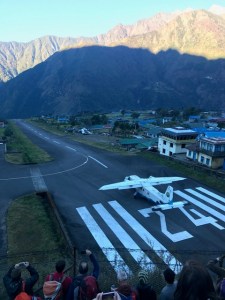
Over the next two days, we met our trip leader, Bhala, and the six other hikers going on our trip. We toasted to our upcoming adventure with Everest lagers while we adjusted to the new time zone. We visited Katmandu again and, without the weariness of the long journey, it captivated me with its bright colors, prayer flags, bicycle taxis, crowded markets, and unique charm. We would leave early the next morning to fly to Tenzing-Hillary Airport, also known as Lukla Airport. It was rated as the most dangerous airport in the world due to its extremely short runway nestled at 9,337 feet amidst the mountains. High winds, cloud cover and changing visibility increase the risk for crashes. Many flights are delayed or cancelled, stranding trekkers for weeks at a time in bad weather. Fortunately, I did not know all this before our trip.

Small Plane Taking Off at Tenzing-Hillary Airport

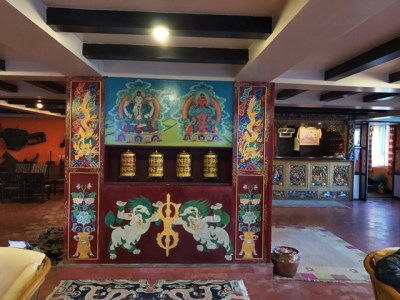
We had an uneventful and beautiful flight through the mountains in a small plane into Lukla on a crisp, clear day. Our pilot was one of the first female pilots in Nepal. I felt safer knowing she had to work twice as hard and be twice as good to get her job. The small town of Lukla is quiet, colorful, and picturesque situated in the beautiful Himalayan mountains. We flew to Lukla with our trip leader, Bhala, and met our two assistant guides there, as well as our three porters who would carry our duffle bags while we hiked. Each porter carries three thirty-pound bags on his back while each hiker hikes with a day pack. We could not have done this trip at high altitudes without our guides and porters. We spent our first night in a charming lodge with colorful prayer wheels in the lobby and small clean rooms with crisp linens and blankets. We ate a simple meal in the lodge dining room and were told to be ready early the next morning.

The Charming Lodge Lobby in Lukla

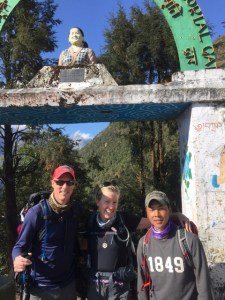
We started our trek through the National Luminary Pasang Lhamu Memorial stone gate that leads to the hiking path. Pasang Lhamu was the first Sherpa woman to summit Mt. Everest and almost everyone who comes to climb Mt. Everest starts here. It felt momentous to be in the same place where many start their epic travels to climb the highest mountain in the world. Not everyone is lucky enough to return. The morning was sunny, and the mountains rose everywhere around us.

I soaked in the beauty and peacefulness of the trek. There were large boulders along the path covered with Nepalese writing. Our guide, Bhala, who is Buddhist, told us that most of this writing is Buddhist prayers or chants. “Om mani padme hum” is one of the more popular chants meaning “Generosity, ethics, patience, diligence, renunciation, wisdom.” It was a nice meditative chant to repeat to myself as I climbed the path slowly in the sun and felt connected to nature in a way that seemed as distant from my life as a corporate executive, as we were from our home in Atlanta, Georgia. Without the constant line-up of meetings, phone calls and never-ending list of e-mails to open and reply, I was able to slow down and enjoy the spectacular beauty of Nepal.

Nepalese Writing on Boulders Along Our Trek

Our first day of the trek was relatively gentle and only four hours long so that we could get used to hiking in high altitude. We wound up and down wide paths through prayer boulders, prayer flags and small towns where young children would wave and greet us. Along the way we would see donkeys loaded with enormous packs of goods to be delivered to the bigger villages further up the path. There were ramshackle outhouses that were deceptively picturesque on the outside but, consisted only of a hole in the ground on the inside. I had to quickly master the skill of squatting and peeing without falling over or peeing on my pants and hiking boots. Easier said than done on the longer, grueling hiking days. Our next sleeping lodge was simpler and colder, a trend that would continue as we hiked higher and higher into the mountains.

The second and third days of our trek were some of the most difficult. They were much longer, with increased elevation gain and loss, and on rockier paths that made it more difficult to maintain your balance and footing. I walked at my own pace and reflected on where I was in my life journey as I pushed through fatigue and aches to reach our destination. More than fifty years had passed by in my life and I was successful and happy, but I also knew I needed more balance and spirituality. We hiked higher into the magnificent mountains, with views of towns and rivers below. Locals created pop-up drink stands on the stone walls surrounding their homes for the trekkers, and a cold drink was often worth the exorbitant price.

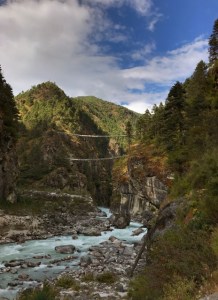
We entered Sagarmatha National Park on day three and crossed over one of the most stunning suspension bridges in the world. In fact, there are two bridges spanning the Dudh Koshi river, one right above the other, and we crossed the highest, newest one. Both are covered with prayer flags waving in the wind. They are nestled in green, tree covered mountains. On this day, the bridge was congested with yaks laden with huge packs and we had to wait to cross until the yaks had cleared the bridge. To be waiting for a yak traffic jam to abate amidst colorful prayer flags fluttering in the wind high in the Himalayan mountains is something everyone should put on their bucket list.

Dudh Koshi River Suspension Bridges

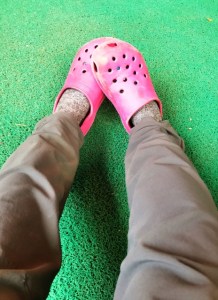
We arrived in our next town tired and hungry. In every lodge where we stayed, the entrance halls had cubbies that were filled with brightly colored crocs. You put your dusty, dirty Yak-poop-filled hiking boots into a cubby and took a pair of crocs that most closely fit your feet. The surprising comfort of pink crocs after a long, arduous day of hiking was wonderful.

My Neon Pink Nepalese Crocs

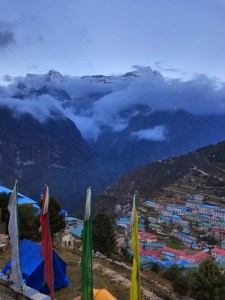
The next day we hiked uphill on our way to the biggest town in the region, Namche Bazaar, the gateway to Mount Everest, situated at 11,286 feet with dramatic views of Mount Everest and Amma Dablam mountains, not reachable by car. Along the path we saw porters hauling huge loads, even refrigerators, on their backs to the town. It filled me with gratitude for every item of food or drink I consumed along my journey. Namche Bazaar has bakeries, cafes and even an Irish pub that is allegedly the most remote Irish pub in the world. I had a creamy latte in a cafe there, feeling indulgent on our spartan journey.

Namche Bazaar from Above

We next visited the beautiful Tengboche Monastery, a Tibetan Buddhist monastery of the Sherpa community. Sherpas are skilled mountain climbers who summit alone or lead hikers up the highest mountains in the region. The monastery is situated at 12,687 feet and is nestled amidst the Himalayan mountains with extraordinary views of Mt. Everest, and all the other well-known mountains in that region. Monks in long robes wandered around the beautiful grounds as we entered through a painted gate topped with golden animals and a dazzling emblem painted with flowers and praying gods. A simple painted sign reminded us that we were entering a holy place where we should “respect worship and meditation.” A list of many rules ended with, “not to kiss please.”

The trip became even more challenging as the altitude increased, the lodges were colder and barren, and the effects of high altitude wore me down, including difficulty sleeping even after an exhausting ten-hour day of hiking. Showers were scarce and lukewarm. In most lodges, the only warm room was the dining room where a large pot-bellied stove heated the room. In your sleeping room, the beds were heated with a hot water bottle which was surprisingly effective when combined with two layers of long underwear, at least until the early morning hours. Dinners were always simple and delicious after our long days.

At this point in the journey, we were travelling on narrow paths winding through the mountains high above the tree lines. There were fewer towns and people along the paths surrounded by breathtaking views. We were approaching our last upward hike to Amma Dablam base camp at 14,000 feet when I suffered severe stomach cramps. Extremely disappointed, I had to take a day of rest and miss the base camp excursion.

We started hiking down to Phortse village the next day and I felt better as the altitude decreased. Our accommodations in Phortse were the barest—small cold rooms with twin beds and no toilets. The outhouse was outside, past the woodpile in the dark of night where I, of course, had to pee three times. Staying hydrated in high altitude has its downsides! The wooden stove in the dining room was fueled by smokey, smelly Yak dung as we were still above the tree line and wood was scarce. The joy of our hosts in our visit, however, easily outweighed the discomforts.

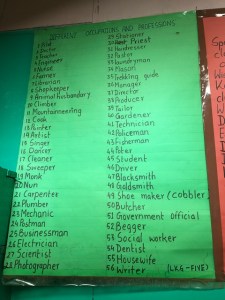
We visited the Phortse school the next day. It was a plain three-room school. There were no indications of 20th century modernity anywhere. The walls were covered with handmade posters and drawings. Lessons written on the walls stated: “Stop early marriage; it is a sin to practice untouchability; both son and daughter are equal.” Another sign listed 56 different occupations and professions, including: pilot, climber, monk, trekking guide, butcher, begger [sic] and last on the list, writer. There was no lawyer on the list as monks resolve disputes in the local communities in Nepal.

List of Nepalese Occupations (No “Lawyer” to Be Found)

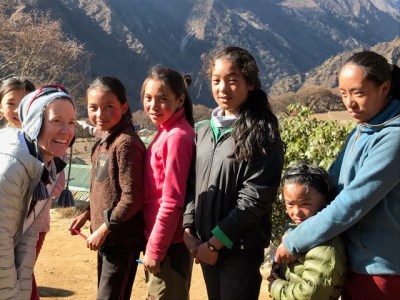
The kids lined up to receive the small gifts that I had brought to share with the school. Gel pens and composite notebooks were greeted with wide smiles. Unlike the schools in the bigger villages, these children, ranging in age from five to thirteen, had no crisp uniforms. Their parents brought them to this meeting and watched cautiously from the side. This was a poor village where the community worked hard for little.

Me with Schoolchidren at Phortse School

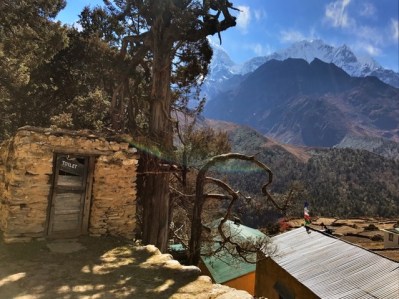
We continued the trip back to Lukla over more flagged suspension bridges, through more small towns amid more spectacular views. Our last night of the trek we stayed at the Mt. Everest View hotel with a dramatic view of Mount Everest. It was supposed to be the nicest lodge on our journey, but the heat and private showers were not working. At this point though, we were used to hot water bottles and shared bathrooms. We knew that we would soon be back in more comfortable hotels. We would miss the stunning mountains, the crisp cool air, the children running to greet us on the rocky paths, the yak and donkey traffic jams, as well as the warmth and generosity of the people of Nepal who welcomed us along our journey. We might even miss the rickety outhouses with signs like “Ladies and Gents,” accompanied by glorious mountain views.

Outhouses with a View

We finished our trip in early November. I was proud of myself for completing a journey that was totally out of my comfort zone. We celebrated with a final dinner where we gifted prized possessions like hats with built in headlamps, warm fleeces and coats to our guides and porters, along with the customary financial tips. We appreciated how they made our trip possible and wanted to give them items they couldn’t buy in Nepal. David and I also followed up with Bhala to establish a fund to help the Phortse school buy uniforms, backpacks, coats, and sneakers for all the kids in the school. We have done that every year since we visited Nepal.

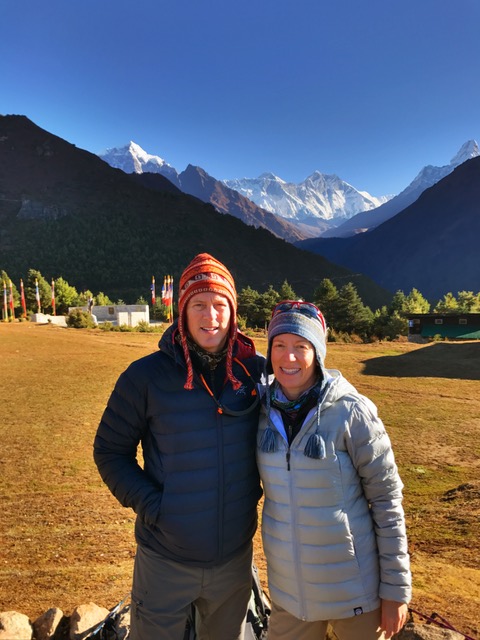
David and I with Our Guide, Ming Ma, at the End of Our Trek

I think often of this beautiful country that helped me connect with nature, trust in my body, and reinvent myself. As Rumi wrote, “It’s your road to walk alone. Others may walk it with you, but no one can walk it for you.” That may be true, but in Nepal, the Nepalese people walking with you made all the difference.

The Shot

I once commented to a Kentucky fan wearing a UK shirt that it was almost perfect, except they forgot the D at the front and the E at the end. He did not appreciate my humor. Kentucky’s hate for Duke runs almost as deep as that of Duke’s biggest rival, The University of North Carolina at Chapel Hill (UNC), and it all goes back to the Duke Kentucky NCAA Region Finals game of 1992.

It was a game for true sports fans– fast paced, high stakes, high scoring, turnovers, steals, breathtaking plays, and an incendiary foul, the memory of which causes any Kentucky fan to go apoplectic to this day. Two highly ranked teams coached by college basketball’s rising stars- Mike Krzyzewski for Duke and Rick Pitino for Kentucky—vied for the chance to play in the Final Four. Forty-five playing minutes of non-stop athletic skill, passion, and drama– it all came down to a final unlikely and legendary shot in overtime. Wikipedia has its own page dedicated to “The Shot.” The Bleacher Report ranks the game as #2 of the top 25 NCAA games of all time. Only the Duke/UNLV 1991 semi-final game ranks higher, the #1 NCAA game of all time. In fact, five of the top 25 NCAA games of all time include a Duke basketball team, a testament to the legendary coaching ability of Mike Krzyzewski, commonly referred to as Coach K.

Some say The Shot should never have happened because Christian Laettner should have been thrown out of the game before that play, but that was not the call and history can’t be rewritten. The Shot lives on as an illustration of the triumph of skill, perseverance, and belief under immense pressure. The ultimate play on a path to back-to-back NCAA championships that had not been achieved since UCLA’s feat under the legendary Coach John Wooden in 1972 and 1973.

My husband, David, and I almost missed the game. We had to go to a party, probably celebrating someone’s engagement or upcoming baby- we did a lot of those celebrations in those days. I’m sure that it was something we felt was impossible to miss, because otherwise no exception for real time watching of all Duke NCAA tournament games would have been made in the house of Payne. Between the two of us, we spent seven years in Durham, North Carolina, each obtaining Duke undergrad and law degrees and watching lots of Duke basketball live in Cameron Indoor Stadium.  We have searched high and low for sports bars around the world to watch Duke NCAA basketball games live. I remember cheering wildly in a small bar on St. Martin when Duke redeemed its 1990 NCAA tournament final blowout loss to UNLV by beating them in the incredible 1991 NCAA semi-final.[1]

We arrived at this party in Washington D.C. in the Spring of 1992, and I was under strict orders not to discuss any live updates I might hear with David as we were going to watch the game later at home. He wanted to be surprised- to feel like he was watching it live. Maybe we were even a bit overconfident that the game was going to go Duke’s way. Duke was, after all, the reigning NCAA champion and the past season had been one of Duke’s best. Their record going into the tournament was 25-2 with only two losses. Duke had been ranked as the top team in the nation every week of the regular season. But, as everyone who watches the NCAA tournament knows, anything can happen. That’s why they call in March Madness and what makes it so exciting and fun to watch.

Sometime into the evening, David became aware that someone had turned the television on in a side room to watch the game. It was during the first half. David’s plan to wait until later to watch the game was foiled. He was immediately sucked in and called me over with a silent wave. We surreptitiously watched the game unfold.

The two basketball teams in the match-up were exceptional. Kentucky was coming off a two-year postseason ban due to major recruiting violations committed by Rick Pitino’s predecessor, Eddie Sutton. The teams four seniors, three of whom were Kentucky natives, had remained loyal to Kentucky and stayed with the program despite the bans. They were Richie Farmer, Deron Feldhaus, John Pelphrey and Sean Woods, referred to as “The Unforgettables” by Kentucky fans. Sean Woods described his commitment to Kentucky as follows, “I’ve been a Big Blue fan since birth.” The Wildcats’ biggest star, however, was sophomore Jamal Mashburn who would go on to have a 12-year career in the NBA, and later become an ESPN NBA analyst.

Duke was entering the game as the returning NCAA champions. Christian Laettner, Bobby Hurley and Grant Hill were its key players returning from the 1991 Blue Devils championship team. Christian Laettner would be the NCAA college player of the year and go on to win a gold medal at the 1992 Olympics as part of The Dream Team. All three players would go on to play in the NBA. Grant Hill became the most celebrated NBA player of that Duke 1992 team, playing in the NBA for 19 years, earning the NBA Co-Rookie of the year in 1995 and was a 7x NBA All-Star. Thomas Hill, Antonio Lang, and Brian Davis were three underrated, but incredible and dependable players who held the team together in close games. Duke won the ACC tournament in 1992 defeating UNC by twenty points, 94-74, to enter the NCAA tournament on a high note alongside its 25-2 winning regular season record.

The game was about halfway through the first half and tied. Duke’s transition game was fast and furious. The pace and intensity of the game almost jumped off the television. Bobby Hurley’s three-point shot making prowess was only exceeded by his innate, superlative passing ability. An alley-oop pass to Grant Hill from Hurley where Hill catches the ball mid-air above the basket and slam dunks it before touching the ground felt like a choreographed dance move in the Bolshoi Ballet. Hill’s grace in rising and flying above the court was unmatched in this game.

Christian Laettner with his poised follow through, becomes the all-time leading scorer in NCAA history in the first half of the game, a record among many that he still owns today. But Kentucky’s defense was fierce. Famous for its Wildcat defense, Rick Pitino said, “If our press doesn’t work, we won’t win.” In the first half of the game, Kentucky forced 11 turnovers leading to 15 points, while Duke forced 5 turnovers leading to 5 points. At halftime, Duke led 50-45, shooting 72 percent for field goals versus Kentucky’s 50 percent.

Our plan to watch the game on a delayed basis at our home was not going to work. We could not miss the second half of this exciting game. But, like fools, we had planned to meet our friends, Jim and Julie, for a late dinner at a local bar and restaurant. I honestly don’t know what we were thinking when we planned this evening. We left the party soon after the first half of the game concluded and set out to meet our friends. We turned the game on the radio so that we wouldn’t miss a play.

The second half started out strongly in Duke’s favor. The Wildcats only hit one basket in the first eight minutes of the second half. Duke is up 56 to 48 with thirty-two minutes to go. The fast pace continues. The radio commentator notes that Duke’s Brian Davis lost a contact under the basket after a series of multiple missed attempts and under-the-basket collisions. Players crawl under the basket looking for the lost lens. At this point in the game, Duke is out rebounding Kentucky 25 to 11. The plays continue rapidly as Duke builds its lead to 64-55. Kentucky’s big man Martinez fouls out and Hurley hits a three pointer to bring Duke’s lead to double digits, 67-55. The plays continue to astound as each team is playing to win, knowing that otherwise it would be the last college game for many of them.

At this point, we careen into the restaurant parking lot, park the car, and sprint in. We beeline to the bar where the game is playing, and a crowd is cheering loudly. Mashburn has come alive, and the game is now 67-57. He hits a three pointer that brings KY back and Duke is only up by seven points, 67-60. The game continues wildly, several baskets made and after another Kentucky three pointer, Duke is only up by five points 73-68. Laettner takes the ball down the court to the basket and is roughly fouled by freshman Aminu Timberlake. As Laettner steps over Timberlake, he stomps on his chest in pointed retribution for the foul. The commentators discuss the foul. “That was a nasty situation. I don’t know if Christian Laettner did it on purpose or not,” says one commentator. “Yeah, he did,” emphatically responds the other. People at the bar are booing loudly. Laettner is called for a technical foul.

Laettner shoots two baskets first because he was fouled. Amidst loud boos in the stadium, he calmly makes both baskets easily. Swoosh. Swoosh. Richie Farmer for Kentucky shoots the Kentucky technical shots and only makes one of the two baskets. The score is 75-69. Duke makes two more baskets and is suddenly up by ten points again with seven and half minutes to go. The minutes fly by with non-stop action as Kentucky is on a run and their scoring heats up. Incredulously, the game is tied at 81-81 with just over five minutes left. Kentucky’s three key players Woods, Pelphrey and Brown each have four fouls.

Players race up and down the court making miraculous plays and baskets until the game it tied 91-91 with two minutes to go. Duke scores 2 points. Then Kentucky scores two points. It’s 93-93 and Hurley has the ball. He takes it down the court, shoots, and misses. Kentucky calls a time out and the referees confer on how much time is left on the clock. Eight tenths of a second is put on the clock and Mashburn inbounds the ball for Kentucky. If Kentucky scores, they will win the game. Kentucky fans are screaming wildly at the bar. David and I clench our teeth hoping for Kentucky to fail. The inbound pass to Pelphrey is knocked out by Duke and no time remains. The game heads to overtime.

We haven’t even let our friends know that we are at the restaurant. We can’t miss any more of this game. Overtime starts and we are glued to the bar watching the big screen tv among our new friends and enemies. Grant Hill takes the ball to the basket and misses. Pelphrey hits a massive three pointer for Kentucky. Duke heads back down the court and is called for an offensive foul by Brian Davis who fouls out of the game. The game is tilting quickly in Kentucky’s favor. Kentucky has the ball and Thomas Hill steals, passes to Hurley who shoots for three and misses. Grant Hill rebounds and quickly passes the ball back to Hurley who scores three to tie the game, 96-96. Pelphrey scores two for Kentucky. Then Laettner takes the ball back down the court with two minutes remaining in the game and is fouled by Mashburn, his fourth foul. Laettner makes both free throws to tie the game again, 98-98.

With 1:46 left in the game it’s Kentucky’s ball. Woods takes on Hurley and misses. Duke has the ball. With only five seconds left on the shot clock, Hill passes it to Laettner who makes an off balance shot that miraculously drops. The announcer yells, “How did he get that shot off?” Duke leads 100-98. Mashburn shoots, makes the two-point basket, and is fouled. He makes his free throw bringing the score to 101-100 for Kentucky. Kentucky calls time out. With 19.6 seconds left, it is Grant Hill to Hurley to Laettner who is fouled by Mashburn, who fouls out of the game. Laettner again makes both free throws and Duke is up 102-101. Time out for Kentucky to formulate their final play.

With 7.8 seconds left on the clock. Kentucky inbounds the ball and Woods quickly scores for Kentucky 103-102. With only 2.1 seconds left on the clock, Duke needs a miracle. The announcer asks, “Will the dream die here for Duke?” Duke needs a shot, one that will go down in history. The Shot unfurls. Unguarded on the inbounds play, Grant Hill threw the ball 79 feet to Laettner who is at the opposite court foul line. Laettner dribbles right, then turns left to put up the buzzer beating, game winning shot to give Duke a 104-103 victory. The shot is eerily reminiscent of his buzzer beating overtime shot against Connecticut that advanced Duke to the 1990 NCAA Final Four. We scream loudly and jump up and down wildly at the bar, high fiving complete strangers, in total amazement at this final play.

We rush to find our friends, who were forgiving of our lateness until Jim, who went to UNC, heard the reason. To this day, I still can’t believe Laettner calmly dribbled the ball in a fake to the right before he let loose the game winning shot to his left, with less than two seconds to seal the game winning play. It was the culmination of thousands of hours of practice, playing games, and a patience and confidence that is rarely witnessed. And, it could have gone either way. Laettner finished the game with 31 points and seven rebounds. He was a perfect 10-10 from the field and 10-10 from the free throw line that night. His only imperfect moment was his intentional foul on Timberlake, which drew a technical foul for his team.

Duke went on to beat Indiana in the semi-final game in another tight match. A bittersweet victory for Coach K to beat his former mentor, Bobby Knight, in his last attempt for an NCAA championship. And then, Duke went on to beat Michigan’s Fabulous Five by twenty points to win its second NCAA championship in a row—recreating a feat that had not been accomplished since 1973 by John Wooden.

So, now you know more about The Shot than you might ever have wanted to know. You might hate Duke more, or hate Duke less, or not care about Duke at all. But I hope my memory has increased your appreciation of how a single play can clinch the biggest of games.

As Doug Boyd says in the last stanza of his not famous, but hilarious song “1992”

            ’92 is ancient history

            In the NCAA

            But the ghost of Christian Laettner

            Haunts Kentucky to this day


[1] Notably, Duke’s win over UNLV in the 1991 semi-final NCAA game stopped UNLV from winning back-to-back NCAA championships for 1990 and 1991.

On Brave Old Army Team

Like fireflies signaling on a hot, summer night of my youth, my first and only experience watching the Army-Navy game in person burned brightly for me, ephemeral, not to be repeated.

I grew up for most of my formative years at West Point, New York, the home of the storied United States Military Academy. My friends’ fathers were professors or in West Point leadership- one friend’s dad was the Dean, one was the Head of Admissions, another’s dad was the head of the Math department, and one was the head of the Athletic program. My dad was an aeronautical engineer who headed up the fluid Mechanics section of the Mechanical Engineering department. Our mothers were smart, dedicated and, among their many talents, knew how to throw an amazing dinner party- ready to host the endless flow of visiting guests to such a unique place.

It was an extraordinary place to grow up. Stunningly beautiful, overlooking the Hudson River, with imposing grey stone buildings and statues of fearless military leaders—such as Grant, Patton, McArthur—throughout the campus. We had free reign in the huge and impressive cadet gym, as long as we entered after 3 p.m. and showed our military dependent ID card. We swam in Delafield Pond and dove off the 36-foot-high diving platform that would never exist today due to potential liability. We rode our bikes or the campus shuttle bus to traverse the sprawling base. It was safe and filled with friends from all over the United States, as the military brings together people from all walks of life.

There were many rites of passage to being a military brat at West Point, but one that I remember clearly was Army football. You had to know it and love it. Some might argue that the real West Point motto is Duty, Honor, Country, and Army football. We lived just down the hill from the beautiful and impressive Michie stadium where Army played its home games. My dad attended West Point and graduated in 1956, back in the halcyon days of Army football. In its heyday, Army football was considered by many to field some of the best teams in the nation. The 1945 team took on six of the best teams in the country and beat them by an average of 45-6. Army has had three Heisman Trophy winners (the best college football player in the nation): Doc Blanchard (1945), Glenn Davis (1946) and in my father’s era, Pete Dawkins (1958). I grew up at West Point in the 1970s, long after the glory days of Army football had faded, but my dad and many other faithful fans always remained steadfast in their belief that Army would rise again.

Football season was a season-long fall celebration at West Point. Almost everyone on base had season tickets and the academy issued a beautiful poster with a game slogan for each game. My dad faithfully hung them on our front door for every game and saved them carefully. When my parents bought a small cottage in upstate New York, my dad papered an entire downstairs room with these saved posters and slogans. His loyalty ran deep.

The Army fight song, which my dad sang to us frequently for inspiration or irritation—sometimes it was hard to tell which emotion he intended—rang out throughout the base on game day:

The Army team’s the pride and dream
Of every heart in gray.
The Army line you’ll ever find
A terror in the fray.


And when the team is fighting
For the Black and Gray and Gold,
We’re always near with song and cheer
And this is the tale we’re told:


The Army team

The Army team
Rah! Rah! Rah! Boom!


On, brave old Army team!
On to the fray.
Fight on to victory
For that’s the fearless Army way.

Michie Stadium sits high on a hill at West Point. It is near the beautiful Cadet Chapel, where my friend’s dad was the Chaplain for years and he showed us the secret door from his adjoining house to sneak into the chapel at night. It is right across from Lusk Reservoir where the gorgeous yellow, red, and orange fall leaf colors are reflected in the water on beautiful New York fall days. I didn’t have the chance to sit and watch too many football games growing up as I had highly coveted jobs—working concessions or babysitting for an entire season. I remember one year I paid special attention to the football season because my Sunday School teacher, Bob Johnson, was the first black captain of the football team, taught Sunday School and fought cancer all at the same time. An impressive person to have as a mentor in your life.

If you were an Army fan, the pinnacle of the entire season was the Army-Navy game which is almost always held on neutral ground in Philadelphia, PA–equidistant from West Point and the Naval Academy. My mom and dad would throw viewing parties where we all cheered maniacally for Army to beat Navy. My dad even taught our dog a trick that centered on this main event. He would ask our dog if he would rather be in the Navy or “Be Dead.” Without fail, Cuddles rolled over theatrically with all four paws in the air and his head lolling over to the side. Later, when I went to Duke for college, my dad taught our dog to perform his trick for Carolina too. A perfect symmetry for transferring his acting skills from one legendary college rivalry to another.

The Army-Navy game is one of the oldest college rivalries. It is between the Army Black Knights and the Navy Midshipman and has been televised nationally since 1945. For the first two-thirds of the twentieth century, both Army and Navy were often among the best teams in the nation, and the game sometimes had national championship implications. Although the teams have not had the same national prowess since those days, the game has endured as a national institution. Part of this is due to the respect our country pays to those who put their lives on the line to defend our nation. The pageantry of seeing all the young Army cadets in grey, black, and gold and the Midshipmen (and women) in navy blue and white singing their fight songs, alma matres and our national anthem adds to the glorious spectacle of a legendary rivalry. The winning team’s alma mater is always played last and the phrase “sing second” is slang for winning the big game. Through the 2021 meeting, Navy leads the series 62-53-7.

My senior year in high school, I finally got the opportunity to go see the Army-Navy game in person. My best friend, Tory Rogers (whose dad was the Head of Admissions) and I were offered a ride to Philadelphia with some friends. Tory made a reservation for a room for the two of us at the iconic Ben Franklin hotel in Philly. This was the place to be and where everyone stayed who was going to the game. We were certain that this was going to be the road trip of a lifetime. To this day, I’m not sure why my parents thought it was a good idea to allow two seventeen-year-olds who had never been away for a weekend unsupervised to do this. If they had fully understood the chaos that ensued following the big game, I’m sure they would have reached a different conclusion.

Tory and I were inseparable friends in high school. Tory was the “It Girl”—pretty, athletic, funny and everyone loved her. I was her best friend and along for the ride. We even dated twins one year in high school, but that was a distant memory by our senior year. As seniors, we vowed to not date anyone seriously and just enjoy our last year of high school before we headed off to college, Tory to Dartmouth, and me to Duke. Many more college road trips back and forth between these locations would ensue in our future.

On Saturday morning, December 2, 1978, we loaded up in the car with some friends for our short two-and-a-half-hour drive to Philly. We planned to drive straight to the game and then go check in at our hotel afterwards. We were beyond excited for the big event.

On, brave old Army team!
On to the fray.
Fight on to victory
For that’s the fearless Army way.

The game on that cold December day was unfortunately a blowout. Army could never get their footing and Navy defeated Army 28-0. No fight song was going to fix that score. But somehow even the disappointing game could not dim our enthusiasm—the beauty of being in the grand stadium with our friends, the uniformed service men and women, and all the Army fans made the experience worth it despite the humbling loss.

We arrived at the Ben Franklin hotel after the freezing and disheartening game and were ready to check into our rooms and began the post-game festivities. We planned to drown our sorrows amidst friends and fellow Army supporters. The lobby was large, beautiful, and crowded with cadets and fans. The line was long to get to the front desk, but the excitement of the crowd carried us through.

When we got to the front to check in, the receptionist asked us for our names and Tory responded with excitement. The woman said, “Hmmm, I’m not seeing a Tory Rogers, could it be under another name?” Tory paused and said, “Maybe Victoria Rogers?” “The woman searched and politely stated that she was not seeing a reservation under either of those names. The receptionist then asked if Tory had confirmed her reservation with a credit card or by mailing a check. Tory paused and said, “I don’t think anyone told me to do that? Can I just pay you now?” The sympathetic clerk responded that Tory’s reservation had most certainly been let go and paying now was not an option as all the rooms were reserved. At this point, I very unhelpfully looked at Tory and said, “You didn’t pay for our room?” Tory turned to me with an icy stare—which I fully deserved—that silenced me immediately. She said, “That’s not helpful. We don’t have a room and I don’t know what to do about that now.” Several of the cadets in line behind us gleefully and loudly offered us space in their rooms for the night. We wisely declined, laughed, and almost cried our way over to our friends.

Our friends also offered to let us sleep in their room, but since they already had way too many people crowded in, we decided then and there to just wing it. After all, we were on the road trip of a lifetime so we figured we would go all in. We’d heard the after-game parties were legendary and went all night, so why not just go with the flow. Who’s going to let a bed and a good night’s sleep interfere with an epic adventure? We stored our bags in our friends’ room and started the evening exploits.

It was a hilarious evening from start to finish and something we had never experienced. Every floor in the hotel had a different party going on. The doors to most of the rooms were propped open to facilitate the wandering. One room seemed to contain the entire Army hockey team. We kept seeing everyone we knew. Tory kept asking, “How did they get a room?” To which I would respond with a laugh, “Perhaps they sent in their check?” The elevators were crammed with revelers. How we stayed together in the time of no cell phones was a miracle. We mourned Army’s loss, wondering what the parties would be like if they had won. We lasted until 4 a.m., at which time we made our way back to the beautiful lobby and collapsed into two big wing backed chairs in the corner and fell asleep. Our friends found us a bit later that morning and tapped our shoulders to wake us up to head back to New York. I’m sure we slept the whole ride home.

Stanford Distinguished Careers Institute: Second Quarter Reflections

I’ve finished my second quarter as part of the Stanford Distinguished Careers Institute (DCI). Here are my continuing reflections on this amazing experience. It’s hard to believe that I’m already halfway through my DCI year.

If you are looking at my site for the first time, here’s a description of the Stanford Distinguished Careers Institute (DCI) and me, Kathy Payne.

What was different about this quarter?

I felt much more at home on the Stanford campus. I now know my way around the beautiful, sprawling campus. I’ve visited many of the buildings, stunning artworks, and hidden spaces. I sometimes just stop in awe at how gorgeous the campus is and how lucky I am to be here for a year. I don’t worry anymore that the undergrads might be wondering who the old person in the class is. I just go and participate. They’ll figure it out—they are at one of the best schools in the nation after all. And I continue to be amazed at how brilliant, kind, and thoughtful they all are. They give me great hope for the future.

What classes did I take this quarter?

I totally overdid it this quarter. I took 9 classes plus continued in my book club on “The Meaning of Life” and got a personal trainer. It’s hard to say no to all the interesting classes to take and things to do here. I also took on a consulting project that took a lot of time as well. It’s funny, I’ve blamed a lot of tiredness on work over the years, but I’ve realized that I am a significant part of the problem. I just do too much and find it hard to do things halfway. Although I will probably be an overachiever until I die, I vow to have more “white space” for spontaneity and friendships this quarter. My friend Kristian has said that he is going to sign me up for the “half-assed improvement program” so that I learn how to do things “half-assed.” Ha! We’ll see how that goes! I have signed up for fewer classes in the spring quarter. That’s a start!

For Winter Quarter I took 3 undergrad classes, 2 DCI only classes (taught by Stanford professors), 3 Stanford continuing education classes, and 1 Stanford rec class. I loved all my classes again!

Additionally, every Tuesday night we continue to meet as a DCI group and hear a guest lecture from a different Stanford professor each week. At these meetings, one or two people in our class present a twenty or thirty-minute presentation called a Life Transformation Reflection (LTR). These are always very powerful and moving presentations on something meaningful and transformative in their life. I am working on my LTR which will happen in May. Stay tuned.

Here are short descriptions of my classes:

  1. Campaigns, Voting and Media. This class met 2x a week and was taught by Prof. Shanto Iyengar. He literally wrote the book on this subject. What an amazing, but also rather depressing class. Did you know that most people are set in a political identity by the time they are 5 and rarely change? Also, political identity is driving so many opinions these days regardless of the facts. For example, although the economy is still very important for people in voting, most people now view the economy primarily through the lens of their party. Republicans think the economy is good when a Republican president is in power and not when a Democrat president is in power. Vice versa for Democrats. What I loved most about this class is that every student gave a presentation on a current issue, e.g., race in politics, negative campaign advertising etc. It was truly fabulous to see how passionate, smart, and informed the students are. I learned a lot!
  2. Chinese Politics. This class met 2x a week and was taught by Prof. Jean Oi. Again, amazing class. Prof. Oi is an expert on Chinese politics. I learned so much about the history of China (Mao, Tiananmen Square, Xi Jinping) and its complex political institutions, as one of the 5 remaining communist countries in the world today. I have a much better understanding of this huge nation and its impact on the world.
  3. Sports Writing. This class was a DCI only class taught by Prof. John Evans who has written two memoirs. John is an award-winning writer himself and an amazing teacher. This class was a continuation of my Memoir Class, but it was focused on sports writing. We read many fabulous articles and story segments on sports, some focused more directly on sports and some more in the memoir style. My final essay, The Shot, as well as another essay, On Brave Old Army Team, are posted on this blog in the Creative Writing section.
  4. Into the Dunes. It’s hard to explain this class, but it was incredible too. It was taught by Prof. Andrew Todhunter. I recently read his book, A Meal Observed, and I highly recommend it. Like my Redwoods class last quarter, one of the unique parts about this class is that it was taught at the O’Donoghue Family Farm which is an actual organic farm on Stanford’s campus (which is also called “The Farm”). This fact added to the unusual and calming nature of the class- learning outside while butterflies floated by, and birds chirped—even if it was quite a bit colder this quarter. We learned about meditation and writing. We tried all different types of meditation: sketching, writing, walking, sitting, visiting our younger selves, and visiting our older selves in meditation. We spent a day hiking the beautiful Muir Beach together at the culmination of the class. My final essay for this class, A Three-Room School, is posted in the Creative Writing Section of this blog.
  5. Claiming Your Stanford Experience. I was a mentor in this class for Stanford undergrads. The class was about psychogeography, which in its simplest form, is being present in your surroundings and not going from point A to point B, but rather, wandering without a specific destination and taking it all in. As you can imagine, these supremely goal oriented, Type A perfectionist students had never done this before. TBH, neither had I! It was fun! I had a pod of students and we drifted all over campus together. We also visited super cool locations on campus: The Frost Amphitheater, Bing Concert Hall, The Law School hanging gardens, Memorial Church, and Windhover Meditation center. In each location we would do something unique. For example, in Memorial Church we laid down on the pews and experienced a sound bath meditation. Super cool!
  6. What Ails Democracy. This continuing ed class was taught by Prof. Larry Diamond. Prof. Diamond and the guest lecturers in this class were incredible. A fascinating exploration of the troubles in our democracy with some suggestions on how to fix what we can today. Prof. Diamond is a big supporter of ranked choice voting as one solution. He left us with some slides on things we can do for the future. If you’re interested, message me and I can send them your way.
  7. American Prophet: The Life and Legacy of Martin Luther King. This continuing ed class was taught by Dr. Clayborne Carson and Dr. Mia Foster. This was a ten-week class focused on the life and legacy of both MLK, Jr. and Coretta Scott King. Dr. Carson participated in the civil rights movement and was chosen by Coretta Scott King to curate MLK, Jr.’s papers and write his autobiography (in MLK, Jr.’s own words). Dr. Carson and Dr. Foster had access to incredible archival documents and videos, and they curated them in a wonderful and educational way. Great class that reminded me how far we still must go in order to achieve Martin and Coretta’s dream.
  8. Improv. Yes, I finally took a class on Improv. It was over Zoom and it feels like that wouldn’t or shouldn’t work, but it really did. I love the principles of Improv: say yes, be average, make your partner look good, don’t prepare, go with the flow and more. Our class was taught by the legendary Patricia Madson. Her book on Improv is wonderful and truly a metaphor on how to live your life. I highly recommend it.
  9. Tennis. I signed up for an intermediate tennis class with undergrad and graduate students, professors etc. It was every Friday for 1 hour and 40 minutes. Students were from all over- Russia, Israel, Chile, Germany, and more countries. We had a lot of fun and did constant drills and games. Got me back into the swing of tennis!
  10. Book Club on the Meaning of Life. We are such nerds that several of the people in our prior class with Prof. Scotty McLennan decided to continue again on our own. Scotty suggested the books and we continued to read and meet. We read three intense books (WitAll my Sons and Major Barbara) and discussed the Meaning of Life and questions posed in all three books. Fascinating discussions.

What did we do for fun?

We continued to have a lot of fun. I took yoga and met with a personal trainer weekly. We’ve gone on amazing hikes. We took an afternoon day trip with many of our friends along the coast and saw spectacular views ending with a wind tasting on the Santa Cruz pier. Bodi goes on many of our hikes and is now adjusted and happy in California. She is our class mascot, and everyone loves her. She has a Stanford student dog walker (a field hockey player) who she loves and who takes her running every weekday.  Bodi is getting into field hockey shape!

What’s my big takeaway so far?

I continue to love learning and reinventing myself. I’m feeling more centered and very happy to be in CA for a year. I’ve made fantastic friends in this program, and I’ve gotten a whole new perspective on who I am and what I want for my future.

I’m looking forward to next quarter.

Thank you for reading!

A Walk with Bodi

Below is my Final Essay for Invitation of the Redwood Grove.

It is a glorious sunny day in our neighborhood. Temperatures are near perfect at 71 degrees. I’m not sure that anyone who was raised in California can ever appreciate how lucky they are to enjoy this spectacular beauty and weather all year long. Maybe everyone should spend a few winters in New York or Chicago or Boston to really appreciate this gift. I grew up on the banks of the Hudson River in upstate New York where winters were long and cold and windy. I spent many long winters there. I adore California weather.

I ask my dog Bodi if she would like to go on a walk. She loves this word and jumps two feet straight in the air to show her excitement. She is an Aussie Doodle.  Half Australian Shepherd and half Poodle. Eternally happy and hoppy. She is jet black with a large spot of white on her chest, strands of white throughout her tail and on two of her paws. Her hair right around her mouth is turning red. Her coat of fur is thick and extremely soft. People stop and ask to pet her all the time and she seems very proud of that. She is 16 months old and still very much a puppy, even though perhaps she should be beyond this stage.

We head out the door and on our way to the park. Another word that Bodi adores. To me, a park is a lovely green space to go relax or picnic or walk in the sun. To Bodi, a park is one of the most joyous places in the world. It is a place filled with other dogs, people and best of all- squirrels to chase at full tilt with glorious abandon.

We start walking to the park on our beautiful neighborhood street. It is autumn in California and the colors are vivid. Red and yellow leaves on many of the trees. Tall green conifers reaching up to the sky. We see green bushes with red berries boldly screaming to the birds to come eat them for breakfast. We see roses, past their prime, but still beautiful—like aging Hollywood screen star legends.

There are purple flowers reaching upwards to the sun. We pass a tree with yellow fruit that almost looks like oranges. I’m not sure what these are—perhaps persimmons? And then we see fabulous hanging flowers that are beautiful colors of coral and cream.  They look like berries, but they are not. There is a palm tree next to some more beautiful fir trees, a bit out of place, but working to fit in.

Bodi continues her happy, bouncy walk. We pass three Free Little Libraries on our way. I drop two books I have read in the first library that we pass. And, more to Bodi’s liking, we pass three yellow fire hydrants. Viewed by most as mere utilities of safety, but to Bodi these represent a wonderland of aromas. As we near the park, Bodi starts walking faster and pulling on her leash. Her excitement is palpable.

Finally, we arrive at the small, beautiful park. I allow Bodi off the leash which is against the rules, but she is very well trained and returns on commend almost always. She runs around sniffing and looking for squirrels. There is a man lying in the field who appears homeless.  He is repeating the same indecipherable phrases over and over.  Bodi runs over to him and I worry that she will scare him. I call her back and she obeys reluctantly. He seemed quite interesting to her, so she is disappointed that I don’t allow her to visit. I apologize to the man and he says “No Problem” quite cheerily. Maybe he needed some love and affection? Bodi is very good at that.

We continue walking around the small lake in the center of the park. We hear music behind the lake and we wander over that way to listen. A young man is playing the saxophone, and someone is videotaping this session. The music is beautiful and floats softly through the air. I put Bodi back on the leash so that she doesn’t make a cameo appearance.

We walk back around the lake. The fountain in the middle shoots straight up in the sky. It is soft and magical. Continuous. Two ducks swim around it enjoying the spray. There is a sign that says, “Help Keep the Ducks Wild and Free.” It goes on to tell us not to feed the ducks as it causes dependence on human feeding, discourages them from migrating, causes over population and leaves them vulnerable to predators. I whisper quietly to the ducks that they shouldn’t depend on humans anyway—we are notoriously unreliable.

As we continue our walk along the lake, I notice the sun high in the sky sending its glorious beams all along the lake. The lake reflects the sun and shadows. Ripples are spreading from the fountain streams. There are very large fish in the shallows as we walk away from the fountain. They are swimming lazily in the sun. Bodi tries to crawl under the split rail fence for a closer inspection of these odd things. I pull her back slowly.

I find a park bench and sit down for a moment to enjoy the solitude. Bodi jumps up to sit beside me. We relax in the sun as we listen to the fountain, the birds and the soft saxophone music in the distance. I enjoy the warmth of the sun, but I cover up my spot on my wrist where the Melanoma was removed. Despite my constant use of sunscreen, I’m more wary of the sun than I used to be even though the doctor said they got all the cancer. I need to be ever vigilant from now on. I breathe a mediation of gratitude for my health and this day. Our visit to the park has been nearly perfect, except that there were no squirrels for Bodi to chase. She seems very content though. Always a happy dog.

We leave the park to continue our journey home in the sun. We pass two young girls skipping toward the park with their masks on. The sun continues to shine, and we are getting warm. Bodi is panting after her exploration. We see a woman stopping at the Little Free Library where I left my two books. I resist the urge to tell her about them. I think she will enjoy them more if she discovers them on her own.

I notice all the signs along the road. Prepare to stop. Stop. Slow Down, Children Playing. No Parking. There are yard signs as well. We Heart our School. I wonder what the world would be like if we had signs that said: Smile, Relax, Love, Enjoy Life, Be Kind. I see that Christmas wreaths are starting to appear on the doors. One lone house still has all its wild Halloween decorations up despite it being almost December. I feel their pain. It’s hard to keep up.

I pause and look up. I am distracted by two big hawks flying high in the sky. They are circling slowly, gliding softly through the air around three tall conifers. Is that their home I wonder? They are powerful and beautiful all at once. They glide so slowly I feel their elegance. Are they mates? Are they hunting or just enjoying the currents of air above? As Bodi starts to pull on her leash, eager to get home, I wonder if I’ll see these beautiful birds again. Unlike their small prey scurrying on the ground, I can feel respect and awe for them. I can wish to see them again.

As we near our apartment, Bodi finally sees a squirrel. She tenses up. Poises in her hunter’s pose.  But alas, she is on the leash and too close to the road to be set free to attempt to catch her prey. She never catches them. Maybe that is why she likes them so much. Like our walk in the California sunshine, she appreciates the journey, the chase, and the overall ambience and adventure. Luckily, unlike the ducks in the pond, she doesn’t need to catch her dinner and her human is quite reliable and timely, for the most part.

I open the door to our apartment and breathe deeply. Bodi immediately jumps on the coach to cool down and relax. Smile, Relax, Love, Enjoy Life, Be Kind. Another glorious day in sunny California. I’m grateful.

Secrets

She had a secret.  One that I didn’t know until long after she had died.  One that even her son, my father, did not know.  Once revealed, it explained a lot about her.  But I knew Katharine when I was young and that was long before I knew that most adults had secrets and other lives they wished they had lived.  Before I knew that most people lived the lives they were given, or had chosen out of loyalty, or familial duty, or lack of opportunity.

Her name was Katharine Kinard Strozier and if you say her name with a southern drawl and a couple of extra syllables you might feel some of her essence. She was raised in an unusually progressive southern family with many brothers and sisters, a dad who was the President of the local college and a mom who was a professor there. I got to know Katharine, or Grandmaw, when I was 6 and we moved to Rock Hill, South Carolina while my dad went off to war- to be a battalion commander in Vietnam.  

Three states, three different first grade classes and now South Carolina with my Dad out of the picture.  It could have been a train wreck, but it wasn’t.  Katharine seemed to love having us living with her in her pink house on Ebenezer Road.  I’m sure it wasn’t easy to have your daughter-in-law, your two grandkids, a dog and later a cat join your small living space and share your one bathroom, but she didn’t seem fazed by anything. 

Katharine had a pink house with maroon shutters and a pool in the backyard.  She told us it used to be grey with a big flower garden in the back.  When her husband (my grandfather who I don’t really remember except that I called him Big Daddy when I was little) died, she repainted the house (to match the inside of a cedar chest- although it was much pinker), ripped up the flowers and installed a pool.  She swam laps every morning without fail before she went to work at Snelling & Snelling where she helped people find jobs.  Before that she was an English teacher and to this day, when anyone says “lay” incorrectly, I think of her saying: “You lay a book down, you lie yourself down.” 

I remember most vividly how she answered the phone in the hallway of the pink house.  She would pick up the ringing phone and answer: “2867, this is Katharine Strozier speaking.”  Back in the time when only four numbers identified your location and you wanted people to know who it was on the other line. Back when people answered the phone.

She must have been the only person in Rock Hill to have a subscription to The New Yorker because she loved the writing and the cartoons.  We often watched TV together at night in the living room where the one TV set was located.  I remember once when changing channels that we happened upon a televangelist couple named Jim and Tammy Faye Baker on the PTL, or Praise the Lord, show.  Katharine told me adamantly:  “It’s really the Pass the Loot club.  They are all crooks and God doesn’t really factor into anything except that it helps them steal your money.”  She was right. She was a good judge of character.  She did not suffer fools.

She ate the same meals every single day.  Two soft boiled eggs for breakfast (always eaten in an egg cup) with a piece of buttered toast, a grilled hamburger with a piece of toast for lunch, and a grilled hamburger with a baked potato with butter for dinner.  She baked homemade bread every weekend and we ate it all week.  I remember the smell of the bread baking and how it filled the house.  We couldn’t wait to eat it and especially liked it warm from the oven with butter melting into its creases.

She smoked and we didn’t like that.  We wanted her to quit because we heard it was very bad for you.  We gave her a paperweight that said: “Orphan Annie’s parents smoked.”  She laughed at that and kept it despite how obnoxious that was.  She snorted when she laughed really hard and she did it a lot because she laughed a lot. 

Late in life, long after that year we lived with her, Katharine read a novel called Growing Up by Russel Baker.  She decided that she could write a novel about her life growing up as she thought it was much more interesting than Russel Baker’s life. I found it after she died.  She wrote about summers in Black Mountain, North Carolina where they kept their milk in a tin box in the creek so that it stayed cold; her sister Nell getting burned because her nightgown caught fire from standing too close to the fireplace; and, living in Anderson, South Carolina when they were little and had a donkey named Piedmont Cigarettes.  She wrote about all of this in her beautiful loopy cursive writing in a dime store spiral notebook with Michael Jackson on the cover. What a loss that she didn’t get to finish it.  All those untold amazing stories.

Katharine died of complications from Emphysema when I was in law school. Roles were reversed, and she was living with my family at the time.  I cried a lot; she was the only grandparent I had ever really known.

When I was married with kids, after Katharine had died, I discovered that Katharine had a secret she had only told a few people.  She had gotten pregnant when she was a graduate student and her family had sent her to New Jersey to live in an unwed mother’s home, have her child and give that child up for adoption. Even though her family was progressive, that was not something a college President could have– a daughter with an illegitimate child.  She had a baby girl, gave her up for adoption and came home and was told she was to marry Ben Strozier and live in a grey house with flower gardens. She had three boys.  She never knew what happened to that baby girl. I think I now better understood the pink house with the swimming pool and Katharine Kinard Strozier.