Below is the final essay I wrote for my Memoir Writing with John Evans.
I was talking to him again face-to-face. He was healthy and handsome, like he was before the long illness took its toll and did all the terrible damage that cancer does to someone you love. He was wearing his beautiful camel hair jacket with its West Point crest, like he was getting ready to go to church. His hair was full and thick again and there were no scars from the brain surgeries. He looked athletic and vibrant, like the man he was, the man who went helicopter skiing at age 74, and he was waiting—though I didn’t know it yet—to hand me his shoes, so that I could leave him and attend his memorial service. Later I learned that these dreams have a name, “visitation dreams,” when a loved one who has died comes back to see you to comfort you and deliver a message.
*****
It was Father’s Day weekend in June of 2010, and I was home for my dad’s memorial service. It was a service at my parents’ Salt Lake City downtown Presbyterian Church with his friends and family; we would have another military service at West Point in the fall with Honor Guard soldiers and a military gun salute where we would put his ashes in the Crematorium at the West Point Cemetery. Home felt familiar and unfamiliar all at once. It wasn’t the home I grew up in, so there was that. Yet, it was the home my parents had lived in for 20 years, so it had all the family pictures, familiar furniture, and memories of holidays celebrated there over the years. Except one person was missing, perhaps the one person who made it feel like home most of all because his presence was so large, so optimistic, so charismatic, and so loving.
I walked through the house and looked around at the pictures. There were the photos you see in most homes, the ones from schools, vacations, weddings, birthdays, and, of course, the hilarious family portraits where you wonder why you wore what you wore and why you ever thought that hairstyle was flattering. It reminded me of all the houses where we lived before–fourteen of them to be exact. We moved around a lot. My dad was in the military and that’s just the way it was for most military families.
But somehow, as I was remembering growing up with my father, I felt that the photos didn’t really capture our lives; they didn’t capture what it felt like to have Jim Strozier as your father. Those decades were not the time of catching every moment of your life on camera. The skiing, the tennis, the long runs and life growing up with the iconic man who had us buy used ski equipment at the “annual ski swap” and fined us a quarter every time we left the lights on because, “Remember kids, there’s an energy crisis!” He was ahead of his time—so most of those casual moments resided only in my memories.
I remembered mostly living in West Point, New York which is where the U.S. Military Academy is located and where my dad was a soldier and a professor for most of my formative years. West Point is the oldest of all the American service academies and sits on strategic high ground overlooking the Hudson River, just 50 miles north of New York City. My dad was from the south, but our life as a family was lived mostly in the north and my dad always seemed uniquely a blend of the south and the north to me. He grew up being called Kinard and spoke with a soft southern accent, but at West Point he told everyone to call him Jim since no one could pronounce Kinard correctly. This was classic Jim Strozier. He always said, “Don’t sweat the small stuff. Life is long and complicated. Do your best, always do your best, but then move on.”
I remembered running beside him along the Hudson River through the beautiful and historic campus lined with green trees, the statues of Douglas Macarthur, George Patton and Ulysses S. Grant, and the large imposing grey stone buildings, listening to my father’s advice on life. We would run by Trophy Point with its numerous antique cannons and the immense flagpole, where they lowered the flag every day at 5 PM and played Taps throughout the campus as the cars stopped and soldiers stood and saluted with respect. He told me you would never regret being kind and that everyone has a story, a battle they have overcome that we know nothing about. He said you really need to be kindest to the ones who make it the hardest because they are the ones who need it the most. He called it Kissing Frogs.
And if I stopped to rest near the historic and expansive parade grounds where the cadets practiced their drills and had formal military parades, his intense side would come out and he would run circles around me chanting “Quitters never Win and Winners never Quit” and “When the Going gets Tough, the Tough get Going.” He really chanted those sayings and I look back on it and laugh; how did I not understand why I was now so crazy competitive? He told me I could be anything and that I was smarter than the average bear. Here he was, a professor with a PhD in Aeronautical Engineering using Yogi Bear as wisdom. He was all those wonderful contradictions, kind and intense, brilliant and funny, logical and creative, always curious and evolving, surprising us all with his wit and wisdom.
He loved to ski and therefore, so did we. My brother, Jim Jr., and I spent many vacations and long days on the ski slopes with our peanut butter sandwiches in our pockets so we wouldn’t have to stop for breaks -which only slackers did. We needed to maximize our ski time. His last job after he retired from teaching, was being a Mountain Host at Deer Valley in Park City, Utah. He was one of the people in green coats who stood by the ski maps and cheerily told everyone where to ski based on their desires and skill level. He loved it. He said it was his favorite job and whispered to me, “Don’t tell them, but I would do this for free.” He taught all his grandchildren to ski over the years, but he did not make them pack sandwiches in their ski jackets. I guess he grew a bit softer with the next generation.
In 2008, we went to MD Anderson in Houston, TX for his first brain surgery. Their motto is “Making Cancer History,” and we all loved the double entendre in that phrase. When my father woke up from the surgery to remove his Glioblastoma brain tumor, he described a vivid dream where he was skiing with Sanjay Gupta (who had recommended MD Anderson to my dad) and what a wonderful ski run they had had. He said it had been extraordinarily cold, but he and Sanjay just dove right in and carved beautiful runs down the steep slopes, all the way talking about life. I remember him earlier telling me about reading one of Sanjay’s books, Chasing Life, and how to live to be one hundred. I imagined that he and Sanjay had talked about how to work around this terminal cancer problem and reach that goal of 100 years. I had once felt certain then that my invincible dad could do that no problem.
Later, speaking with his neurosurgeon, Dr. Sujit Prabu, he told us the surgery had gone as well as could be expected and that my father should recover for a while and might have another one or two years of life. He reminded us that there was no cure for Glioblastoma brain cancer, although there are always new developments and research so this could bridge Jim to a cure if one is found. Wikipedia is even more blunt in its description of Glioblastoma: “Despite maximum treatment, the cancer always recurs. The typical duration of survival following diagnosis is 12-15 months, with fewer than 3-7% of people surviving longer than 5 years.” Dr. Prabu laughed when I told him about the dream, and said that the operating rooms are kept extremely cold and he was glad to know that Jim Strozier made the most of his time in there, even if he went skiing with the wrong doctor instead of the one who did all the work.
We also played a lot of tennis growing up, on the courts down the hill from our large brick military house that overlooked the Hudson River. He was like a human backboard running to get everything. He had a wicked slice and he never let me win. After our matches on the courts near our house, he always made me run up the many flights of stone steps to our house because we needed to finish strong. Not too long after that first surgery, after my dad had miraculously recovered significantly, but momentarily, I scored two tickets to the 2008 US Open Tennis Championship, and we went together for a fabulous weekend in NYC. It was our first weekend alone together and would be our last. Everything about that weekend was special, the end of summer humid NYC air, the gritty subway ride to Flushing Meadows to see world class tennis, the long dinners and even a Broadway show of South Pacific, where we sat so close to the stage that my dad said he felt the singer was going to literally “wash that man right out of her hair” and on to him. It was wonderful to see him healthy enough to do all that after the arduous journey of tests, surgeries, chemo, radiation, physical therapy, and the grim prognosis with words like “Stage 4,” “recurring” and “incurable.” You fool yourself that this brief intermission from cancer will last.
I had a lot of random memories that kept coming back to me as I wandered through what was now my mom’s house. The poster that my dad had above his workbench that really summed up Jim Strozier’s never wavering optimism. It said, “No Mountain is Insurmountable Once you have the Right Approach.” He always saw the good in people and took time to ask everyone how their day was; he always felt like he was one of the luckiest men in the world. When people asked him how he was doing before he got sick, he would almost always respond that he was terrific, or fabulous, or just awesome. One day as a teenager, I remarked snarkily that he couldn’t always be terrific and he paused, reflected on that, and told me that I was right, but after he had responded how great he was doing to several people, he said he had usually talked himself into it. Only once during his two-year battle with brain cancer did he ever waiver and think he couldn’t beat the odds. Even when he got so sick after the second surgery in Utah that left him incapable of walking again, he still said that God works for the good through all who love him. I was a bit madder at God than Jim Strozier was. I didn’t see the good in all of this.
He wasn’t perfect. None of us are. In fact, his ability to be optimistic and always see the good in people made him sometimes too trusting and not the best advice giver on how to handle the difficult people you meet along the way in corporate America and other places. Maybe it was attending and teaching at an institution where the motto was “Duty, Honor, Country” and the seven Army Values of loyalty, duty, respect, selfless service, honor, integrity, and personal courage were ingrained into everyone there. Or, living by the West Point Honor Code: “A cadet will not lie, cheat, steal or tolerate those who do,” that made him believe strongly in people’s inner character and goodness. He thought you should “kill them with kindness.” I was deep in my career as a lawyer and media executive and not as trusting in people’s good nature in difficult situations. I had seen too many ambitious and “self-serving at all costs” people along my journey. I was more cautious and cynical in my encounters. He was a rare man in a rare ecosystem. Regardless, he appreciated my diligence and advocacy throughout his illness.
He loved his wife (Doris Strozier), God and his country, and probably in that order. He never contradicted Doris, to the point that when I called him on this when I was in high school, he told me a story. He loved to tell stories and took you on long journeys with his tales. He said that my mom and I were his favorite women in the world, but that when I grew up and left home, he would spend the next 25 years with Doris. He paused, smiled wisely, and looked at me and said, “Who would you side with?” I think my response was, “The person who was right,” but I secretly got his point. After he died, I learned that he had turned down a Rhodes scholarship to marry my mom because she had already waited so long for him to complete his schooling.
He served his country honorably- fought in Vietnam and earned a bronze star which is awarded for meritorious service or acts of valor while serving in combat operations. It’s the fourth highest combat award of the U.S. Armed Forces and the ninth-highest military award overall. But what I remember most about my dad being in Vietnam are the postcards, reel-to-reel recorded tapes and beautiful silk pajamas he sent to me. I remember a doll he brought home for me of a beautiful Vietnamese woman who had a long amber yellow gown with black flowers and was holding 3 wicker hats in each of her hands. I remember his deep tan and crewcut when he came home from that long year away fighting a war no one wanted to talk about. And I always remember knowing how much he loved me.
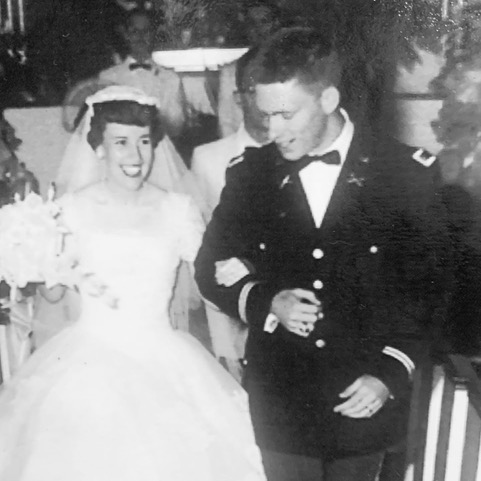
He also loved West Point where he graduated in 1956 at the very top of his class and taught for over 17 years and where we lived for so long. He loved teaching young people and he loved the Army. I always thought he looked so important in his uniform and my favorite one was his “Dress Blues” – a deep blue uniform with yellow insignia, gold buttons with eagles and all his many medals. He wore it on the day I was married instead of a tux because anyone could wear a tux, but very few could wear this uniform. When he died, we realized that most of his passwords were some variations of “Go Army, Beat Navy,” along with his West Point graduation year, 1956. He was a loyal man.
He was first and foremost a teacher- teaching engineering, skiing, Sunday School and life lessons to young kids in need. After retiring from the military, my parents moved to Utah where they could ski a lot and where Jim taught at the University of Utah for another fifteen years. He was named a teacher of the year multiple times. After my father’s death, one of his former students donated money to dedicate a counseling center in the Mechanical Engineering Department to be named after my father. I spoke with this former student who called me because he wanted to tell me how much my father had meant to him. He said he would never have graduated from college without my father’s guidance. He attributed his success (and he was wildly successful as a business entrepreneur) to my father. I’m still amazed that someone I never met felt so passionately about my father that he asked the University of Utah to dedicate a counseling center in his name.
All these memories swirled around as I walked around the house and thought of the eulogy I would deliver at his memorial service the next day. It had been over a month since he died on May 8, 2010- my birthday. Another blow, but also oddly comforting–something about our bond that I couldn’t really describe and a yearly reminder of the gift of life and my amazing father. As I got ready for bed in the guest bedroom, I looked around at all the family pictures from weddings, honeymoons, church directories and of all the grandkids. I hung my clothes in the guest closet which was always too full of my mother’s extra clothes. I settled in to sleep with a deep sadness next to my husband, David, in the too small bed with the lace covered, rust colored comforter before the service the next day.
******
I was looking around the guest room for my shoes. I was stressed about being late for the memorial service. What was I going to wear? My dad was sitting on the edge of the bed. He looked up at me and smiled. He was handsome, happy, and healthy. He looked like he did before the illness. Shocked to see him, I said, “Dad, what are you doing here?” I heard his voice, it was like he was talking to me, but not like that. He said, “I’m going to my memorial service.” I said, “Why are you going to do that?” “Well, of course I’m going,” he said. “I want to hear all the nice things that everyone is going to say about me.” He laughed quietly.
I wasn’t going to make it to the service. I wouldn’t be one of those people saying nice things. I said, “I don’t have any shoes to wear to your service.” I was panicked. He looked at me and said, “Take mine.” It was a beautiful men’s leather shoe and on the bottom of the sole was an exquisite circular imprint, like an engraving, that said: “Made especially for James Kinard Strozier.” I was confused. I knew the shoes wouldn’t fit or look good with my outfit. I told him, “Your shoes won’t fit.” He looked at me very calmly and smiled. “They will fit you perfectly.”
*****
Maybe we all walk in the shoes of those we love when they are gone. Perhaps we do it to honor and remember them; we commemorate them with our walking. Or maybe we simply do it to continue to love them in the only way we can now that they are gone. We wear their shoes because it is our job now to make the journey, and to continue theirs: to try and understand what we could not when they were still alive.
*****
I woke up filled with a sense of calm and peacefulness like I had never felt before. I replayed the dream in my mind and wondered why I didn’t say something like “It’s so good to see you, I love you, you look great,” but it just seemed like those things were there even though unsaid. Most of all, I felt sure that my dad knew how much I loved him and that he was now healthy and at peace. And instead of the heavy sadness that had filled me earlier, I looked forward to the day we were going to have celebrating the life of the amazing James Kinard Strozier.


 A Year at Stanford